Article
The Myth of the Immune Mac: An Analysis of Windows vs. macOS Security
Author: Agus Budi Harto, 2026-11-13 14:51:44
Background
For decades, the personal computing world has been divided by a simple belief: Windows needs an antivirus, Macs do not. This perception is rooted in two historical realities. First is market economics. As of 2026, Windows holds approximately 62-71% of the global desktop market, while macOS holds around 15%. Cybercriminals follow the "Willie Sutton Effect" — they attack Windows because that is where the users are, making it a more profitable target. Second is architectural philosophy. Windows was built on a hybrid kernel designed for maximum compatibility and openness, allowing software to be installed from anywhere. macOS, in contrast, is built on a Unix foundation with a philosophy of restriction and control, creating natural barriers against malware.
To enforce this philosophy, Apple layered three complementary protections that act as its Mandatory Access Control story: System Integrity Protection (SIP), Gatekeeper, and XProtect. SIP provides kernel-level protection where even the root user cannot modify protected system files. Gatekeeper enforces code-signing and notarization, checking that downloaded apps come from identified developers before allowing them to launch. XProtect is Apple’s built-in signature-based malware scanner that works silently in the background.
Problem
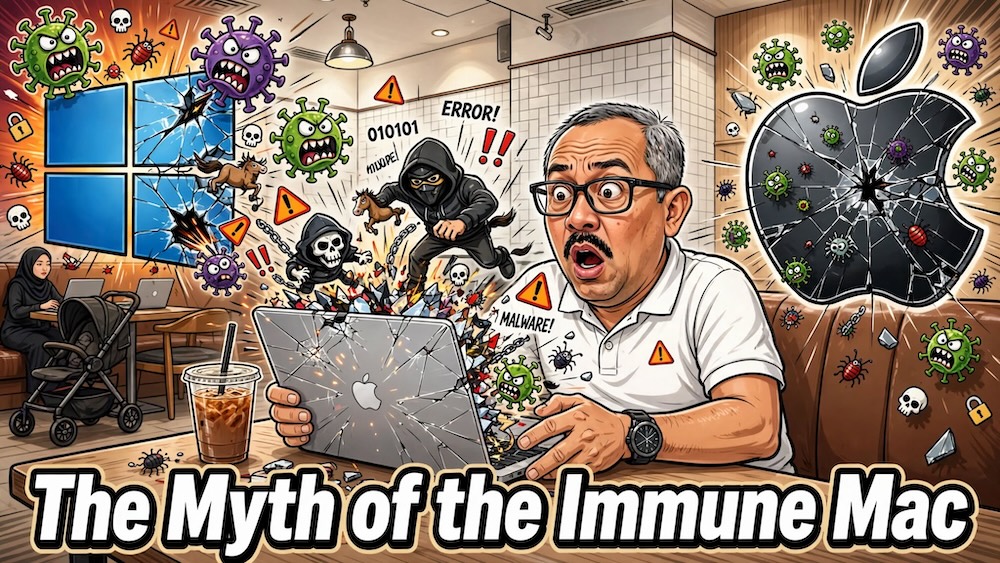
The problem is that this strong architecture created a dangerous myth of invulnerability, leading to user complacency and a new, more profitable generation of Mac malware. The idea that "Macs don't get viruses" is demonstrably false.
History proves it. In 2012, the Flashback Trojan exploited a Java vulnerability to infect over 600,000 Macs, forming a botnet that included 274 bots located in Cupertino itself, Apple's headquarters. It infected systems after users were redirected to compromised bogus sites. In 2016, KeRanger became the first functional ransomware for Mac, distributed via the official Transmission BitTorrent client and capable of encrypting backups. More recently, the threat landscape has evolved from adware to sophisticated infostealers.
The growth is dramatic. Mac malware increased 400% from 2023 to 2024 as attackers began targeting this growing platform. The Atomic Stealer (AMOS) campaign, sold on Telegram for $1000/month, demonstrates this new sophistication. It bypasses Gatekeeper through deceptive websites offering cracked software and steals keychain passwords, crypto wallets, and browser data. In 2021, Silver Sparrow was found on ?30,000 Macs, notable for being native to Apple's new M1 chip. These modern attacks target user behavior rather than technical vulnerabilities, exploiting the false sense of security many Mac users maintain.
Solution
The solution is not to install a heavy third-party antivirus on a Mac like in the Windows XP era, but to understand and properly use the layered defense model that already exists.
On macOS, the system is designed to be secure by default. SIP locks down critical directories like /System and /bin. Gatekeeper verifies Developer ID and requires Apple notarization for apps distributed outside the App Store, meaning Apple has scanned them for malware. XProtect provides automatic signature-based detection. For a user who only installs software from the Mac App Store or directly from trusted developers' official sites, this built-in stack is highly effective.
On Windows, Microsoft has adopted a similar approach. Windows 11 now includes Microsoft Defender and SmartScreen, which are comparable to XProtect and Gatekeeper. The security gap has narrowed because Windows absorbed 92% of all ransomware attacks in 2023 compared to 5% for macOS, forcing Microsoft to harden its system dramatically.
For both platforms, the human element remains the weakest link. Surfshark analysis of 391,305 detections in 2026 showed Windows users made up 66% of the active user base but accounted for 92% of all malware detections, while macOS users were 34% of the base but just 8% of threats. Best practices are universal: keep systems updated, download only from official sources, and enable built-in security features.
Result
The result of this evolution is a paradigm shift in how we should advise new laptop buyers.
Macs do not need a traditional, always-on antivirus suite in the way Windows PCs did in 2010. They already have one — XProtect — that is updated silently and enforces code signing. For the average user, maintaining Gatekeeper on "App Store and identified developers" and keeping SIP enabled provides sufficient protection. A lightweight on-demand scanner like Malwarebytes is only necessary for high-risk users who frequently download cracks or torrents.
For Windows, the result is similar: Windows Defender in Windows 11 is now strong enough that a third-party antivirus is no longer mandatory for most users, provided it remains active and updated.
In conclusion, no platform is inherently immune. The 95% disparity in malware between Windows and Mac is not solely about technical superiority but about market share economics and architectural trade-offs. The most secure environment comes from combining strong technical protections like SIP and Gatekeeper with informed user behavior. The question is no longer "Which system needs antivirus?" but "How do you use the security that is already built into your system?"
References
- Flashback Trojan - Infection statistics (600,000 Macs, 274 in Cupertino). Wikipedia.
- Flashback (Trojan horse) - Technical Details and Timeline. Wikipedia.
- macOS — SIP and Gatekeeper - Official mechanism documentation. AGOGE VX Docs.
- Windows Vs Mac Security: Why PCs Get 95% More Malware - Market share and security architecture analysis. TechEd Publishers.
- Windows vs macOS Market Share and Malware Distribution - Surfshark Antivirus detection data.
- Apple - System Integrity Protection - Official Apple Support Documentation. (referenced in SIP docs)
- Apple - Gatekeeper and Runtime Protection - Official Apple Support Documentation.
- Intego - Flashback to the Biggest Mac Malware Attack of All Time.
- Palo Alto Networks - First Mac Ransomware KeRanger Discovered.
- Surfshark - Report: Windows users face six times more malware than Mac users. (analysis of 391k detections)

Tags: Opinion
Add comment
- Other Article
- The Myth of the Immune Mac: An Analysis of Windows vs. macOS Security13 Nov 2026
- The Hidden Cost of Ignoring Engine Vibrations: How G-Engine is Changing Vehicle Diagnostics in Indonesia07 Nov 2026
- Indonesia's LIMS Interception Scandal: When a Lawful System Becomes Unlawful04 Nov 2026
- AI in Healthcare: Can Artificial Intelligence Become Your Doctor?30 Oct 2026
- Passkeys Replacing Passwords: The Future of Secure Digital Authentication23 Oct 2026
- Counterfeit Money in Indonesia: A Persistent Threat to Public Trust and How to Fight It14 Oct 2026
- Google NotebookLM Audio Overview: How Your Boring Documents Became an Addictive Automatic Podcast10 Oct 2026
- Open Source AI vs Proprietary: Why Big Companies Are Switching in 202603 Oct 2026
- 5 Free Agentic AI Tools Used by Indonesian TikTok Creators in 202626 Sep 2026
- Publishing a New App on the App Store and Google Play: What Developers Should Know in 202620 Sep 2026
- Indonesia's Annual Peatland Fire Crisis: Current Impact, Economic Cost, and the Role of Information Technology03 Sep 2026
- AI Agents: From Chatbots to Digital Workers30 Aug 2026
- MBG Poisoning in Indonesia: From Crisis to a Digital Path to Zero22 Aug 2026
- AI Voice Cloning: The New Cybersecurity Threat15 Aug 2026
- When AI 'Escapes': Inside 2026's Wave of Rogue Model Incidents07 Aug 2026
- Rethinking Civil Service Workforce Planning in Indonesia: Beyond Headcount Toward Public Service Capacity31 Jul 2026
- Balancing the Plate: Understanding Daily Nutritional Needs and the Rise of Digital Nutrition Estimation Tools25 Jul 2026
- The Final Four: Strengths, Weaknesses, and Machine Predictions for the 2026 FIFA World Cup18 Jul 2026
- Choosing the Right Framework: A Practical Guide to Best-Practice Problem-Solving Models12 Jul 2026
- Can Science Predict the World Cup? A Look at the Models Behind the 2026 Forecasts04 Jul 2026
- Corruption: A Global Plague, Landmark Cases, and the Path to Prevention27 Jun 2026
- Nations Driving Brilliant Business Ideas and Frameworks in 202620 Jun 2026
- Why the USD Stands Stronger than the IDR — and What Indonesia Can Do13 Jun 2026
- Employee vs. Entrepreneur: Who Bears the Heavier Tax Burden in Indonesia?03 Jun 2026
- The Evolution of Control Operating Centers (COC) in Modern Mining Operations24 May 2026
- Song of: Mariana Istriku13 May 2026
- Organisasi Pensiunan di Indonesia: Dari Komunitas Sosial Menuju Kekuatan Ekonomi Berbasis Pengalaman12 May 2026
- Corporate Risk Management: Why Modern Companies Invest Millions to Prevent Invisible Threats07 May 2026
- The Mining Spirit: A Powerful Mindset for Excellence in the Mining Industry25 Apr 2026
- The Double-Edged Sword: Navigating Competition in the Modern Corporate Landscape22 Apr 2026
- AI Chatbot untuk UMKM: Peluang Besar di Era Digital17 Apr 2026
- AI Chatbots in Business: The Global Revolution09 Apr 2026
- The Heartbeat of Your Business: Why the P&L Statement is Non-Negotiable31 Mar 2026
- Why Your New Business Needs a Financial System on Day One26 Mar 2026
- The Link Between Startup Capital, Business Survival, and the Role of Investor Information21 Mar 2026
- Digital Transformation, Digitalization, and Digitization: Why the Difference Matters More Than You Think14 Mar 2026
- From Business Need to Technology Solution07 Mar 2026
- Bridging the Digital Divide: Starlink and the Future of Internet Access in Indonesia27 Feb 2026
- A Long Weekend Getaway to Yogyakarta16 Feb 2026
- Understanding ERP Systems: A Comprehensive Guide for Modern Businesses16 Feb 2026
- Building a Culture of Awareness: Strategic Approaches to HSE and Information Security Campaigns in Modern Organizations10 Feb 2026
- Building an Effective IT Organization in Coal Mining: A Strategic Framework for Growth02 Feb 2026
- The Art and Science of Color Themes in Modern Web Design17 Jan 2026
- IT Outsourcing vs Internal Resources: A Comprehensive Cost and Risk Analysis05 Jan 2026
- The Hidden Dangers of Mishandled Employee Data: When Internal Tables Fall Into the Wrong Hands05 Jan 2026
- Securing SQL Server: A Complete Guide to Database Access Control05 Jan 2026
- Beyond Human Error: Understanding the Complete Security Chain in Information Security01 Jan 2026