Article
The Evolution of System Development and the Emergence of SDLC
Author: Agus Budi Harto, 2025-09-03 15:53:16
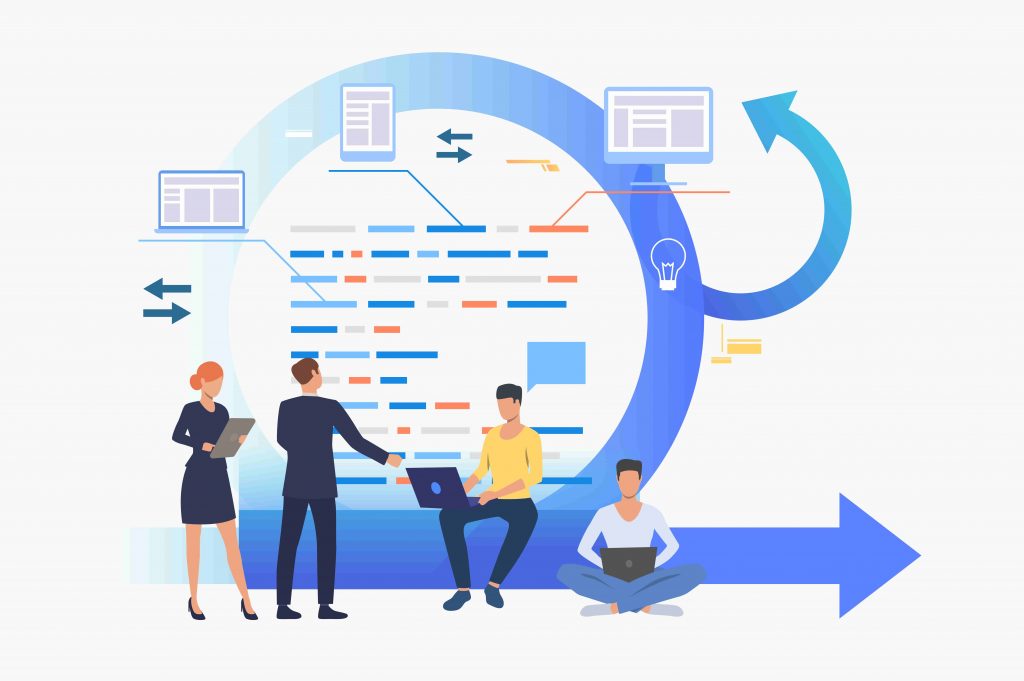 Before the formalization of the Software Development Life Cycle (SDLC), system development was largely ad hoc and lacked standardized processes. Early methods were often linear and documentation-light, relying heavily on individual developer expertise and intuition. These traditional approaches, while sufficient for small-scale systems, struggled to manage complexity, scalability, and quality assurance in larger projects. The absence of structured phases led to frequent miscommunication, scope creep, and software that failed to meet user expectations.
The need for a more disciplined approach gave rise to SDLC—a framework designed to guide software development from conception to deployment and maintenance. SDLC introduced a systematic way to plan, build, test, and deliver software, ensuring that each phase contributes to the overall success of the project.
Understanding the Software Development Life Cycle (SDLC)
SDLC is a structured methodology that defines the stages involved in developing software applications. It ensures that software is built systematically, with clear objectives, measurable progress, and quality control. The primary goal of SDLC is to produce high-quality software that meets or exceeds user expectations, is delivered on time, and stays within budget.
The SDLC typically includes six core phases: requirement gathering, analysis, design, implementation, testing, and maintenance. Each phase has specific deliverables and review processes to ensure alignment with project goals and user needs. SDLC is not a one-size-fits-all model; it can be adapted to suit different project types, team structures, and organizational goals.
SDLC Models and Choosing the Right One
Over time, various SDLC models have emerged to address different project needs. The most common models include:
- Waterfall Model: A linear and sequential approach ideal for projects with well-defined requirements.
- V-Model: An extension of Waterfall that emphasizes testing at each stage.
- Incremental Model: Builds the system in small parts, allowing partial implementation and testing.
- Spiral Model: Combines iterative development with risk analysis, suitable for complex and high-risk projects.
- Agile Model: Focuses on flexibility, collaboration, and rapid delivery, ideal for dynamic environments.
- DevOps Model: Integrates development and operations for continuous delivery and automation.
Choosing the best model depends on several factors: project complexity, risk level, user involvement, and the need for flexibility. For example, Agile is preferred for projects with evolving requirements, while Waterfall suits projects with fixed scopes and clear documentation needs.
SDLC Steps: Descriptions, Outputs, and Examples
Each SDLC phase produces specific outputs that guide the next stage of development. Here's a breakdown using a sample project: Employee Attendance System.
Requirement Gathering
Description: Collect user needs through interviews and surveys.
Output: Business Requirement Document (BRD).
Example: “System must allow employees to log attendance via mobile app.”Requirement Analysis
Description: Analyze feasibility and refine requirements.
Output: Functional Specification Document (FSD).
Example: “Attendance logging requires employee ID and timestamp.”System Design
Description: Create architecture and interface designs.
Output: Design Documents (DFD, ERD, UI mockups).
Example: DFD showing data flow between user, attendance module, and database.Implementation
Description: Develop the software based on design.
Output: Source code and build files.
Example:attendance.js,login.php, database schema.Testing
Description: Validate functionality and performance.
Output: Test cases, bug reports.
Example: “Login test passed; mobile attendance logging failed.”User Acceptance Testing (UAT)
Description: End users test the system in real-world scenarios.
Output: UAT sign-off document.
Example: “All features verified and signed off by project owner.”
Formal References and Cited Journals on SDLC
Several academic sources have extensively studied and cited SDLC methodologies. One notable reference is:
- Lisda et al. (2022) – Systematic Literature Review SDLC in Software Engineering, published in the International Journal of Computer and Information Technology. This paper reviewed 80 scholarly articles and identified the most cited works in SDLC research, including foundational texts by Sommerville and Futrell.
Another widely referenced study is:
- Shravan Pargaonkar (2023) – A Comprehensive Research Analysis of SDLC Models, published in IJSRP. It compares traditional and modern SDLC models and evaluates their effectiveness in software quality engineering.
These references provide a solid foundation for understanding SDLC from both theoretical and practical perspectives, making them valuable resources for academic and professional use.
Tags: Opinion
Add comment
- Other Article
- Open Source AI vs Proprietary: Why Big Companies Are Switching in 202603 Oct 2026
- 5 Free Agentic AI Tools Used by Indonesian TikTok Creators in 202626 Sep 2026
- Publishing a New App on the App Store and Google Play: What Developers Should Know in 202620 Sep 2026
- Indonesia's Annual Peatland Fire Crisis: Current Impact, Economic Cost, and the Role of Information Technology03 Sep 2026
- AI Agents: From Chatbots to Digital Workers30 Aug 2026
- MBG Poisoning in Indonesia: From Crisis to a Digital Path to Zero22 Aug 2026
- AI Voice Cloning: The New Cybersecurity Threat15 Aug 2026
- When AI 'Escapes': Inside 2026's Wave of Rogue Model Incidents07 Aug 2026
- Rethinking Civil Service Workforce Planning in Indonesia: Beyond Headcount Toward Public Service Capacity31 Jul 2026
- Balancing the Plate: Understanding Daily Nutritional Needs and the Rise of Digital Nutrition Estimation Tools25 Jul 2026
- The Final Four: Strengths, Weaknesses, and Machine Predictions for the 2026 FIFA World Cup18 Jul 2026
- Choosing the Right Framework: A Practical Guide to Best-Practice Problem-Solving Models12 Jul 2026
- Can Science Predict the World Cup? A Look at the Models Behind the 2026 Forecasts04 Jul 2026
- Corruption: A Global Plague, Landmark Cases, and the Path to Prevention27 Jun 2026
- Nations Driving Brilliant Business Ideas and Frameworks in 202620 Jun 2026
- Why the USD Stands Stronger than the IDR — and What Indonesia Can Do13 Jun 2026
- Employee vs. Entrepreneur: Who Bears the Heavier Tax Burden in Indonesia?03 Jun 2026
- The Evolution of Control Operating Centers (COC) in Modern Mining Operations24 May 2026
- Song of: Mariana Istriku13 May 2026
- Organisasi Pensiunan di Indonesia: Dari Komunitas Sosial Menuju Kekuatan Ekonomi Berbasis Pengalaman12 May 2026
- Corporate Risk Management: Why Modern Companies Invest Millions to Prevent Invisible Threats07 May 2026
- The Mining Spirit: A Powerful Mindset for Excellence in the Mining Industry25 Apr 2026
- The Double-Edged Sword: Navigating Competition in the Modern Corporate Landscape22 Apr 2026
- AI Chatbot untuk UMKM: Peluang Besar di Era Digital17 Apr 2026
- AI Chatbots in Business: The Global Revolution09 Apr 2026
- The Heartbeat of Your Business: Why the P&L Statement is Non-Negotiable31 Mar 2026
- Why Your New Business Needs a Financial System on Day One26 Mar 2026
- The Link Between Startup Capital, Business Survival, and the Role of Investor Information21 Mar 2026
- Digital Transformation, Digitalization, and Digitization: Why the Difference Matters More Than You Think14 Mar 2026
- From Business Need to Technology Solution07 Mar 2026
- Bridging the Digital Divide: Starlink and the Future of Internet Access in Indonesia27 Feb 2026
- A Long Weekend Getaway to Yogyakarta16 Feb 2026
- Understanding ERP Systems: A Comprehensive Guide for Modern Businesses16 Feb 2026
- Building a Culture of Awareness: Strategic Approaches to HSE and Information Security Campaigns in Modern Organizations10 Feb 2026
- Building an Effective IT Organization in Coal Mining: A Strategic Framework for Growth02 Feb 2026
- The Art and Science of Color Themes in Modern Web Design17 Jan 2026
- IT Outsourcing vs Internal Resources: A Comprehensive Cost and Risk Analysis05 Jan 2026
- The Hidden Dangers of Mishandled Employee Data: When Internal Tables Fall Into the Wrong Hands05 Jan 2026
- Securing SQL Server: A Complete Guide to Database Access Control05 Jan 2026
- Beyond Human Error: Understanding the Complete Security Chain in Information Security01 Jan 2026