Article
Corporate Risk Management: Why Modern Companies Invest Millions to Prevent Invisible Threats
Author: Agus Budi Harto, 2026-05-07 18:48:12
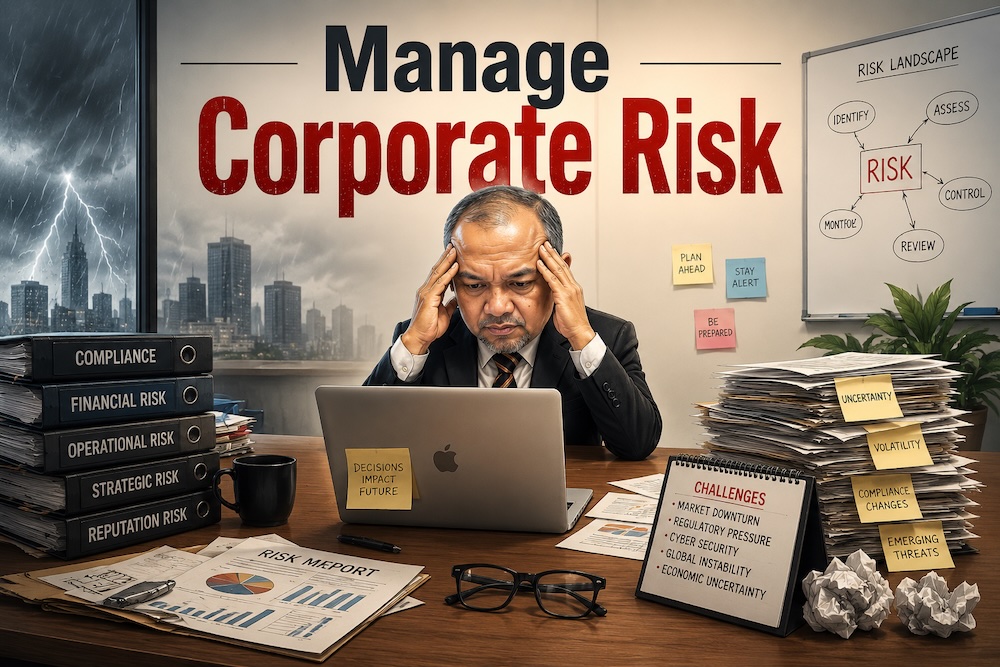
In today’s business environment, companies are no longer threatened only by declining sales or aggressive competitors. Modern organizations operate in an ecosystem filled with interconnected uncertainties: cyberattacks, regulatory changes, supply chain disruptions, financial volatility, employee turnover, geopolitical instability, reputational crises, and rapidly evolving technology. A single unmanaged risk can trigger a domino effect capable of disrupting operations, damaging public trust, and even threatening the survival of the company itself.
This reality has transformed risk management from a secondary administrative function into one of the most strategic pillars of corporate sustainability. Organizations across industries are increasingly recognizing that risk is not merely something to avoid, but something to understand, monitor, and manage intelligently. Companies that fail to build strong risk management practices often discover too late that the true danger was not the original incident, but the chain reaction that followed afterward.
Understanding Corporate Risk in the Modern Era
Corporate risk refers to any uncertainty that can negatively affect an organization’s ability to achieve its objectives. These risks may originate internally through operational weaknesses and human error, or externally through economic, political, technological, environmental, and market-related factors.
In the past, businesses primarily focused on traditional financial risks such as debt exposure or market fluctuations. However, the modern risk landscape has become significantly broader and more complex. Today, companies must simultaneously manage strategic risks, operational risks, compliance risks, cybersecurity risks, reputational risks, environmental risks, and human capital risks.
A cyberattack, for example, is no longer just an IT problem. It can escalate into operational shutdowns, customer dissatisfaction, legal penalties, reputational damage, investor distrust, and substantial financial losses. Similarly, a small compliance failure can evolve into regulatory investigations, public scandals, and long-term brand deterioration.
Because risks are interconnected, organizations increasingly adopt Enterprise Risk Management (ERM), a structured framework that evaluates risks across all departments and aligns mitigation strategies with corporate objectives.
Major Categories of Corporate Risk
Modern companies generally classify risks into several major categories.
Strategic Risk
Strategic risks emerge from business decisions that may fail to produce the expected outcomes. Examples include failed expansion strategies, disruptive competitors, changing consumer behavior, poor mergers and acquisitions, or inability to adapt to technological change.
Companies that underestimate strategic risk often lose market relevance over time. History has shown many once-dominant businesses collapsing because they failed to anticipate digital transformation or changing industry trends.
Operational Risk
Operational risks arise from failures in internal processes, systems, infrastructure, or human resources. These may include production downtime, logistics failures, workplace accidents, defective products, or system outages.
Operational disruptions directly impact customer experience and service reliability. In highly competitive markets, repeated operational failures can quickly erode customer loyalty.
Financial Risk
Financial risks relate to cash flow instability, currency fluctuations, liquidity problems, credit exposure, fraud, and investment losses.
Poor financial risk management can create severe consequences, particularly during economic downturns when companies require strong liquidity and financial resilience to survive market uncertainty.
Compliance and Legal Risk
Organizations must comply with laws, industry standards, taxation rules, labor regulations, data protection requirements, and governance obligations. Failure to comply can result in penalties, lawsuits, regulatory sanctions, and license suspension.
As governments worldwide strengthen regulations related to privacy, ESG, anti-corruption, and cybersecurity, compliance risk management has become increasingly important.
Cybersecurity and Technology Risk
Digital transformation has significantly increased corporate exposure to cyber threats. Ransomware, phishing attacks, data breaches, insider threats, and cloud vulnerabilities can disrupt operations within minutes.
Technology risk is now considered one of the fastest-growing business threats globally because digital dependency continues to expand across every industry.
Reputational Risk
Reputational risk may be intangible, but its consequences can be devastating. Negative publicity, social media backlash, unethical behavior, poor customer service, or environmental incidents can rapidly destroy public trust.
In the digital era, reputational crises spread faster than ever before. A single viral incident may affect customer confidence, investor sentiment, and employee morale simultaneously.
Why Companies Appoint Dedicated Risk Management Teams
As corporate risks become more complex, many organizations establish dedicated risk management structures to oversee identification, mitigation, monitoring, and reporting activities.
Large enterprises often create formal Enterprise Risk Management divisions led by a Chief Risk Officer (CRO). These teams work alongside operational departments, compliance units, cybersecurity specialists, finance teams, and internal auditors.
Modern risk governance usually follows the widely recognized “Three Lines Model”:
- The first line consists of operational departments that own and manage risks directly.
- The second line includes risk management and compliance teams that provide oversight and frameworks.
- The third line consists of internal audit functions that independently evaluate effectiveness and control maturity.
This structure ensures accountability throughout the organization. Every significant risk should have a clearly assigned owner responsible for monitoring exposure levels and executing mitigation plans.
Key Performance Indicators in Risk Management
Risk management effectiveness cannot rely solely on intuition or subjective judgment. Therefore, organizations establish measurable Key Performance Indicators (KPIs) to monitor risk exposure and mitigation performance.
Common risk management KPIs include:
- Percentage of mitigation plans completed on time
- Reduction in high-risk incidents
- System recovery speed after disruptions
- Regulatory compliance scores
- Cybersecurity incident frequency
- Employee safety performance
- Audit findings closure rates
- Downtime reduction metrics
- Business continuity readiness levels
Mature organizations increasingly use Key Risk Indicators (KRIs), predictive analytics, and real-time monitoring dashboards to detect early warning signs before incidents escalate into crises.
The Financial Reality of Managing Corporate Risk
One of the most frequently discussed topics in corporate governance is the cost of managing risks. Building an effective risk management ecosystem requires substantial investment in people, technology, training, compliance systems, cybersecurity infrastructure, audits, insurance, and business continuity planning.
For many businesses, risk management costs typically range between 0.5% and 3% of annual revenue. However, heavily regulated industries such as banking, insurance, healthcare, mining, energy, and fintech may spend between 3% and 10% of revenue due to higher compliance obligations and cybersecurity exposure.
Cybersecurity alone now consumes a significant portion of enterprise risk budgets. Many organizations allocate between 5% and 15% of their total IT spending to cybersecurity programs, reflecting the growing threat of digital attacks.
Despite these expenses, experienced executives understand that prevention costs are usually far lower than failure costs. Investing several million dollars in cybersecurity protection may prevent catastrophic losses worth tens or hundreds of millions caused by ransomware attacks, operational shutdowns, legal liabilities, and reputational damage.
This principle is often described through the concept of Total Cost of Risk (TCOR), which measures not only insurance costs but also retained losses, compliance expenses, operational disruptions, recovery costs, and risk administration expenditures.
TCOR=Insurance+Retained Losses+Risk Management Administration+Compliance Cost+Cybersecurity+Business Continuity
Organizations with mature risk management systems generally experience lower long-term losses, faster recovery times, stronger investor confidence, and better operational stability.
Risk Management as a Strategic Investment
In earlier decades, many executives viewed risk management primarily as a cost center or regulatory obligation. That perspective has changed dramatically.
Today, investors, regulators, customers, and business partners increasingly evaluate companies based on resilience, governance quality, cybersecurity maturity, sustainability practices, and crisis readiness.
A strong risk management culture helps companies:
- maintain operational continuity during disruptions,
- protect shareholder value,
- strengthen stakeholder trust,
- improve decision-making quality,
- enhance strategic resilience,
- and recover faster from crises.
Companies with weak risk governance often suffer from reactive management, fragmented decision-making, and escalating crisis costs. Meanwhile, organizations with mature risk cultures are better equipped to navigate uncertainty and capitalize on emerging opportunities.
In an unpredictable global economy, risk management is no longer simply about avoiding disasters. It has evolved into a fundamental discipline for sustaining growth, protecting reputation, and ensuring long-term business survival.
Conclusion
Corporate risk management has become one of the defining capabilities of modern organizations. From operational disruptions and cyber threats to regulatory pressures and reputational crises, companies face a constantly evolving landscape of interconnected risks.
To address these challenges, businesses increasingly establish dedicated risk management teams, implement structured governance frameworks, define measurable KPIs, and invest heavily in prevention, monitoring, and resilience strategies. Although the cost of managing risks can be significant, the financial and reputational consequences of ignoring them are often far greater.
Ultimately, successful organizations understand that risk management is not about eliminating uncertainty entirely. Instead, it is about building the capability to anticipate disruptions, respond effectively, and continue operating with confidence in an increasingly complex world.
References
- ISO 31000 Risk Management
- COSO Enterprise Risk Management Framework
- The IIA Three Lines Model
- Gartner Security and Risk Management Spending Forecast
- PMI PMBOK Guide Standards
- Basel Committee on Banking Supervision

Tags: Opinion
Add comment
- Other Article
- Passkeys Replacing Passwords: The Future of Secure Digital Authentication23 Oct 2026
- Counterfeit Money in Indonesia: A Persistent Threat to Public Trust and How to Fight It14 Oct 2026
- Google NotebookLM Audio Overview: How Your Boring Documents Became an Addictive Automatic Podcast10 Oct 2026
- Open Source AI vs Proprietary: Why Big Companies Are Switching in 202603 Oct 2026
- 5 Free Agentic AI Tools Used by Indonesian TikTok Creators in 202626 Sep 2026
- Publishing a New App on the App Store and Google Play: What Developers Should Know in 202620 Sep 2026
- Indonesia's Annual Peatland Fire Crisis: Current Impact, Economic Cost, and the Role of Information Technology03 Sep 2026
- AI Agents: From Chatbots to Digital Workers30 Aug 2026
- MBG Poisoning in Indonesia: From Crisis to a Digital Path to Zero22 Aug 2026
- AI Voice Cloning: The New Cybersecurity Threat15 Aug 2026
- When AI 'Escapes': Inside 2026's Wave of Rogue Model Incidents07 Aug 2026
- Rethinking Civil Service Workforce Planning in Indonesia: Beyond Headcount Toward Public Service Capacity31 Jul 2026
- Balancing the Plate: Understanding Daily Nutritional Needs and the Rise of Digital Nutrition Estimation Tools25 Jul 2026
- The Final Four: Strengths, Weaknesses, and Machine Predictions for the 2026 FIFA World Cup18 Jul 2026
- Choosing the Right Framework: A Practical Guide to Best-Practice Problem-Solving Models12 Jul 2026
- Can Science Predict the World Cup? A Look at the Models Behind the 2026 Forecasts04 Jul 2026
- Corruption: A Global Plague, Landmark Cases, and the Path to Prevention27 Jun 2026
- Nations Driving Brilliant Business Ideas and Frameworks in 202620 Jun 2026
- Why the USD Stands Stronger than the IDR — and What Indonesia Can Do13 Jun 2026
- Employee vs. Entrepreneur: Who Bears the Heavier Tax Burden in Indonesia?03 Jun 2026
- The Evolution of Control Operating Centers (COC) in Modern Mining Operations24 May 2026
- Song of: Mariana Istriku13 May 2026
- Organisasi Pensiunan di Indonesia: Dari Komunitas Sosial Menuju Kekuatan Ekonomi Berbasis Pengalaman12 May 2026
- Corporate Risk Management: Why Modern Companies Invest Millions to Prevent Invisible Threats07 May 2026
- The Mining Spirit: A Powerful Mindset for Excellence in the Mining Industry25 Apr 2026
- The Double-Edged Sword: Navigating Competition in the Modern Corporate Landscape22 Apr 2026
- AI Chatbot untuk UMKM: Peluang Besar di Era Digital17 Apr 2026
- AI Chatbots in Business: The Global Revolution09 Apr 2026
- The Heartbeat of Your Business: Why the P&L Statement is Non-Negotiable31 Mar 2026
- Why Your New Business Needs a Financial System on Day One26 Mar 2026
- The Link Between Startup Capital, Business Survival, and the Role of Investor Information21 Mar 2026
- Digital Transformation, Digitalization, and Digitization: Why the Difference Matters More Than You Think14 Mar 2026
- From Business Need to Technology Solution07 Mar 2026
- Bridging the Digital Divide: Starlink and the Future of Internet Access in Indonesia27 Feb 2026
- A Long Weekend Getaway to Yogyakarta16 Feb 2026
- Understanding ERP Systems: A Comprehensive Guide for Modern Businesses16 Feb 2026
- Building a Culture of Awareness: Strategic Approaches to HSE and Information Security Campaigns in Modern Organizations10 Feb 2026
- Building an Effective IT Organization in Coal Mining: A Strategic Framework for Growth02 Feb 2026
- The Art and Science of Color Themes in Modern Web Design17 Jan 2026
- IT Outsourcing vs Internal Resources: A Comprehensive Cost and Risk Analysis05 Jan 2026
- The Hidden Dangers of Mishandled Employee Data: When Internal Tables Fall Into the Wrong Hands05 Jan 2026
- Securing SQL Server: A Complete Guide to Database Access Control05 Jan 2026
- Beyond Human Error: Understanding the Complete Security Chain in Information Security01 Jan 2026