Article
The Evolution of Control Operating Centers (COC) in Modern Mining Operations
Author: Agus Budi Harto, 2026-05-24 19:31:31
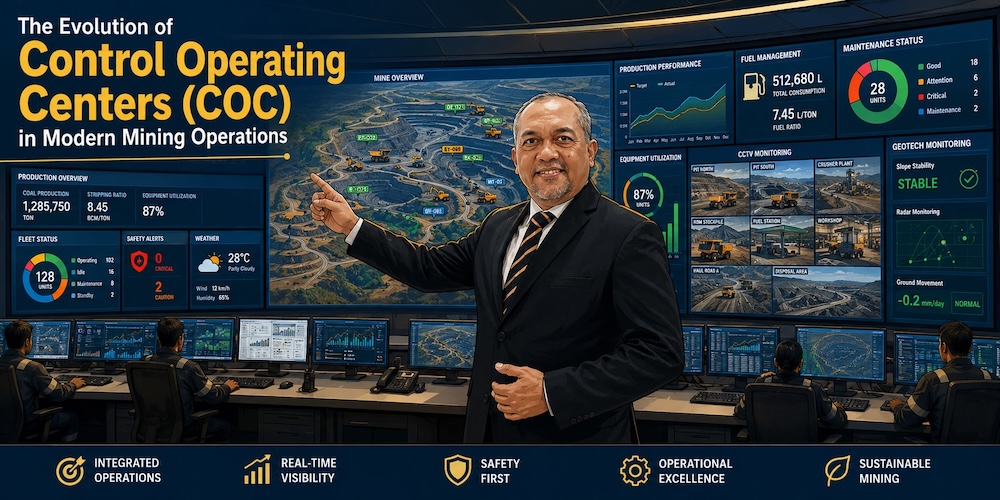
The global mining industry is currently undergoing a major transformation driven by digitalization, automation, artificial intelligence, and integrated operational management. One of the clearest manifestations of this transformation is the rapid development of the Control Operating Center (COC), also known in advanced mining environments as the Integrated Operations Center (IOC) or Remote Operations Center (ROC).
Historically, mining operations were highly decentralized. Production monitoring, maintenance coordination, dispatching, safety supervision, and fuel management were handled independently by different departments in separate locations across the mine site. This fragmented approach often created operational silos, delayed decision-making, reduced productivity, and increased operational risks.
Today, modern mining companies increasingly adopt centralized control environments where operational data from across the mine is collected, analyzed, visualized, and acted upon in real time. Contemporary COCs integrate fleet management systems, IoT sensors, dispatch systems, geotechnical monitoring, weather intelligence, maintenance analytics, CCTV surveillance, and enterprise systems into a unified command environment.
Large mining corporations worldwide have already implemented highly sophisticated integrated operation centers. Companies such as Teck Resources, Rio Tinto, BHP, and other global miners operate centralized facilities capable of remotely monitoring thousands of instruments and coordinating autonomous haul truck fleets from locations hundreds or even thousands of kilometers away from the mine itself. Modern mining control rooms increasingly resemble aviation operation centers or Formula-1 race control rooms, emphasizing data-driven decision-making, predictive analytics, and operational optimization.
The Role of COC in Open Pit Coal Mining
In open pit coal mining, the COC serves as the operational nerve center of the mine. Due to the complexity and scale of open pit operations, centralized operational visibility becomes essential to ensure production continuity, safety compliance, fuel efficiency, equipment utilization, and risk mitigation.
Unlike underground mining, open pit coal mining involves extensive hauling activities, large heavy equipment fleets, multiple pit areas, dynamic weather conditions, and high operational dependency on real-time coordination. As a result, operational delays in one area can quickly affect the entire mine-to-port production chain.
A modern open pit coal mining COC therefore functions not merely as a monitoring room, but as a real-time operational command environment capable of coordinating all critical mining activities.
Core Components That Should Exist in a Modern Mining COC
A well-designed coal mining COC should contain several integrated operational domains.
1. Fleet Management System (FMS)
The fleet management system forms the operational backbone of the COC. It monitors haul trucks, excavators, dozers, graders, loaders, and support vehicles in real time.
The system should display:
- equipment location,
- payload,
- cycle time,
- idle duration,
- queue time,
- fuel consumption,
- operator activity,
- utilization rates,
- and production performance.
Modern FMS platforms also support AI-assisted dispatch optimization and predictive operational analysis.
2. Dispatch and Production Monitoring
The COC should continuously monitor:
- overburden removal,
- coal extraction,
- hauling productivity,
- crusher throughput,
- stockpile balance,
- and production targets versus actual achievement.
Dispatch systems are essential to balance truck allocation among excavators, minimize queue times, and optimize production flow.
Integrated operations philosophy emphasizes optimization of the entire mining value chain instead of isolated departmental performance.
3. Fuel Management System
Fuel is one of the largest operational expenses in open pit mining. Consequently, fuel monitoring should be fully integrated into the COC.
The system should include:
- fuel issuance monitoring,
- automated dispensing,
- RFID or QR verification,
- abnormal fuel usage detection,
- fuel inventory management,
- and theft prevention analytics.
4. Safety and Fatigue Monitoring
Mining remains a high-risk industry, making safety systems a critical component of the COC.
The center should integrate:
- AI-enabled CCTV,
- fatigue monitoring cameras,
- collision avoidance systems,
- proximity detection,
- emergency alarms,
- and real-time incident escalation mechanisms.
Advanced systems are increasingly capable of detecting unsafe behavior automatically using computer vision technologies.
5. Geotechnical and Environmental Monitoring
Slope failures and unstable pit walls represent major operational hazards in open pit mining. Therefore, geotechnical monitoring systems should feed directly into the COC.
Recommended monitoring tools include:
- slope radar,
- prism monitoring,
- piezometers,
- vibration sensors,
- and rainfall monitoring systems.
Environmental monitoring should also include:
- dust levels,
- water discharge,
- weather conditions,
- lightning detection,
- and road condition monitoring.
6. Maintenance and Asset Health Monitoring
Mining equipment availability directly affects production capability. The COC should therefore include maintenance visibility and predictive maintenance analytics.
The monitoring environment should display:
- equipment health status,
- engine diagnostics,
- breakdown alerts,
- Mean Time Between Failure (MTBF),
- Mean Time To Repair (MTTR),
- and maintenance backlog indicators.
ISO 55001 has become one of the most important references for asset-intensive industries such as mining because it provides structured guidance for lifecycle asset management and operational reliability.
Recommended Room Size and Physical Layout
The size of the COC depends on mine scale, number of pits, fleet size, and organizational complexity.
For a medium-to-large open pit coal mining operation, a realistic COC configuration may include:
- a 3x3 video wall configuration,
- 6–12 large display panels,
- operator workstations,
- supervisor consoles,
- meeting and escalation areas,
- and server/network support facilities.
Typical room recommendations are:
- Mining Scale Recommended Room Size
- Small Operation 6 x 8 meters
- Medium Operation 8 x 12 meters
- Large Operation 15 x 20 meters
- Enterprise ROC >20 x 30 meters
A modern COC should also include:
- ergonomic workstation design,
- 24/7 shift operation capability,
- redundant power supply,
- controlled lighting,
- acoustic management,
- and secure access control.
Organizational Ownership of the COC
Operationally, the COC is typically managed by the Mining Operations Department or Integrated Operations Division because the center directly controls daily production activities.
However, the COC is inherently cross-functional and requires continuous collaboration among:
- mining operations,
- dispatch,
- maintenance,
- geotechnical engineering,
- safety,
- fuel management,
- environmental teams,
- and logistics.
In advanced mining organizations, a dedicated role such as:
- Integrated Operations Manager,
- Mine Control Superintendent,
- or Operational Excellence Manager
The COC should not operate as a passive monitoring room. Instead, it should function as an active operational decision-making center with clearly defined escalation authority and incident management procedures.
The Critical Role of IT Within the Mining COC
The involvement of the IT organization in the COC is fundamental. Without strong IT architecture, modern mining COCs cannot function effectively.
The IT department is responsible for:
- communication infrastructure,
- data integration,
- cybersecurity,
- cloud connectivity,
- database reliability,
- network redundancy,
- system interoperability,
- and disaster recovery.
Modern mining operations increasingly rely on:
- IoT sensors,
- LTE mining networks,
- fiber optic communication,
- edge computing,
- digital twins,
- AI analytics,
- and cloud-based operational systems.
As AI adoption accelerates within mining, IT organizations are becoming strategic operational partners rather than merely support functions. Recent industry developments show that mining companies are integrating AI directly into operational workflows such as maintenance planning, production optimization, and predictive analytics.
Cybersecurity also becomes increasingly important because operational technology (OT) and information technology (IT) environments are now highly interconnected. Therefore, mining organizations frequently align COC implementation with standards such as:
- ISO 27001,
- ISO 22301,
- ISO 31000,
- and ISO 55001.
International Standards and Best Practice References
Several international standards and frameworks commonly serve as references for modern mining COCs.
Key ISO Standards
- International Organization for Standardization ISO 55001 — Asset Management
- ISO 31000 — Risk Management
- ISO 45001 — Occupational Health & Safety
- ISO 14001 — Environmental Management
- ISO 27001 — Information Security
- ISO 22301 — Business Continuity Management
- Industry Frameworks and Operational References
Modern mining organizations also reference:
- Integrated Operations (IO) philosophy,
- Fleet Management System architecture,
- SCADA integration models,
- operational excellence frameworks,
- and digital mining transformation strategies.
The mining industry increasingly emphasizes enterprise-wide operational integration rather than isolated optimization of individual departments.
Conclusion
The evolution of Control Operating Centers reflects the broader transformation of the mining industry toward intelligent, connected, data-driven operations. In open pit coal mining, the COC is no longer simply a monitoring facility but a strategic operational platform capable of improving productivity, reducing operational risk, strengthening safety culture, and enabling real-time decision-making.
As mining operations become increasingly automated and digitally integrated, the importance of centralized operational visibility will continue to grow. Future mining COCs are expected to incorporate even more advanced capabilities such as autonomous fleets, AI-assisted dispatching, digital twins, predictive operational intelligence, and remote mine management.
Organizations that successfully integrate operational technology, information technology, asset management, and operational governance within their COC architecture will likely achieve significant advantages in operational efficiency, safety performance, and long-term sustainability.
References
- ISO 55001 Overview
- NQA – What is ISO 55001
- ICMM Official Website
- Caterpillar MineStar System
- Hexagon Mining Solutions
- MiningFMS – Integrated Operations in Mining
- Resource Works – Modern Mining Control Room
- Reuters – Mining Industry Digital Transformation

Add comment
- Other Article
- Open Source AI vs Proprietary: Why Big Companies Are Switching in 202603 Oct 2026
- 5 Free Agentic AI Tools Used by Indonesian TikTok Creators in 202626 Sep 2026
- Publishing a New App on the App Store and Google Play: What Developers Should Know in 202620 Sep 2026
- Indonesia's Annual Peatland Fire Crisis: Current Impact, Economic Cost, and the Role of Information Technology03 Sep 2026
- AI Agents: From Chatbots to Digital Workers30 Aug 2026
- MBG Poisoning in Indonesia: From Crisis to a Digital Path to Zero22 Aug 2026
- AI Voice Cloning: The New Cybersecurity Threat15 Aug 2026
- When AI 'Escapes': Inside 2026's Wave of Rogue Model Incidents07 Aug 2026
- Rethinking Civil Service Workforce Planning in Indonesia: Beyond Headcount Toward Public Service Capacity31 Jul 2026
- Balancing the Plate: Understanding Daily Nutritional Needs and the Rise of Digital Nutrition Estimation Tools25 Jul 2026
- The Final Four: Strengths, Weaknesses, and Machine Predictions for the 2026 FIFA World Cup18 Jul 2026
- Choosing the Right Framework: A Practical Guide to Best-Practice Problem-Solving Models12 Jul 2026
- Can Science Predict the World Cup? A Look at the Models Behind the 2026 Forecasts04 Jul 2026
- Corruption: A Global Plague, Landmark Cases, and the Path to Prevention27 Jun 2026
- Nations Driving Brilliant Business Ideas and Frameworks in 202620 Jun 2026
- Why the USD Stands Stronger than the IDR — and What Indonesia Can Do13 Jun 2026
- Employee vs. Entrepreneur: Who Bears the Heavier Tax Burden in Indonesia?03 Jun 2026
- The Evolution of Control Operating Centers (COC) in Modern Mining Operations24 May 2026
- Song of: Mariana Istriku13 May 2026
- Organisasi Pensiunan di Indonesia: Dari Komunitas Sosial Menuju Kekuatan Ekonomi Berbasis Pengalaman12 May 2026
- Corporate Risk Management: Why Modern Companies Invest Millions to Prevent Invisible Threats07 May 2026
- The Mining Spirit: A Powerful Mindset for Excellence in the Mining Industry25 Apr 2026
- The Double-Edged Sword: Navigating Competition in the Modern Corporate Landscape22 Apr 2026
- AI Chatbot untuk UMKM: Peluang Besar di Era Digital17 Apr 2026
- AI Chatbots in Business: The Global Revolution09 Apr 2026
- The Heartbeat of Your Business: Why the P&L Statement is Non-Negotiable31 Mar 2026
- Why Your New Business Needs a Financial System on Day One26 Mar 2026
- The Link Between Startup Capital, Business Survival, and the Role of Investor Information21 Mar 2026
- Digital Transformation, Digitalization, and Digitization: Why the Difference Matters More Than You Think14 Mar 2026
- From Business Need to Technology Solution07 Mar 2026
- Bridging the Digital Divide: Starlink and the Future of Internet Access in Indonesia27 Feb 2026
- A Long Weekend Getaway to Yogyakarta16 Feb 2026
- Understanding ERP Systems: A Comprehensive Guide for Modern Businesses16 Feb 2026
- Building a Culture of Awareness: Strategic Approaches to HSE and Information Security Campaigns in Modern Organizations10 Feb 2026
- Building an Effective IT Organization in Coal Mining: A Strategic Framework for Growth02 Feb 2026
- The Art and Science of Color Themes in Modern Web Design17 Jan 2026
- IT Outsourcing vs Internal Resources: A Comprehensive Cost and Risk Analysis05 Jan 2026
- The Hidden Dangers of Mishandled Employee Data: When Internal Tables Fall Into the Wrong Hands05 Jan 2026
- Securing SQL Server: A Complete Guide to Database Access Control05 Jan 2026
- Beyond Human Error: Understanding the Complete Security Chain in Information Security01 Jan 2026