Article
Scrum: An Agile Evolution Beyond Traditional SDLC
Author: Agus Budi Harto, 2025-09-03 16:10:54
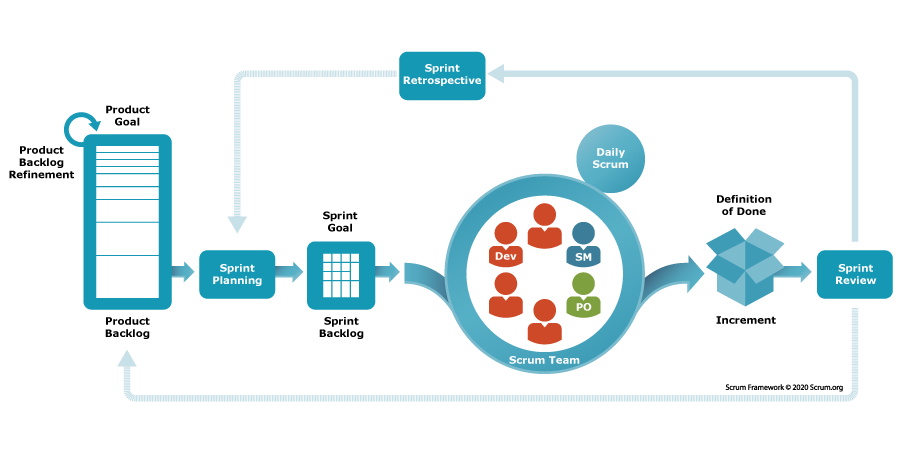
For decades, software development was governed by traditional methodologies such as the Waterfall model, which followed a rigid, sequential process. While these models provided structure and predictability, they often struggled to accommodate change, user feedback, and rapid delivery—especially in dynamic business environments. As software systems grew more complex and user expectations evolved, the limitations of traditional Software Development Life Cycle (SDLC) models became increasingly apparent. This paved the way for more adaptive and iterative approaches, with Scrum emerging as one of the most influential frameworks in modern software engineering.
Scrum is not a replacement for SDLC but rather an evolutionary enhancement. It retains the core principles of structured development—such as planning, implementation, testing, and delivery—but reimagines them through the lens of agility, collaboration, and continuous improvement. At its core, Scrum is a lightweight, iterative framework that enables teams to deliver high-value software in short, manageable cycles called sprints. Each sprint typically lasts two to four weeks and results in a potentially shippable product increment, allowing for rapid feedback and course correction.
One of the defining features of Scrum is its emphasis on people and interactions over processes and tools. The framework introduces specific roles—Product Owner, Scrum Master, and Development Team—each with clear responsibilities that foster accountability and transparency. Daily stand-up meetings, sprint reviews, and retrospectives ensure that communication remains fluid and that the team continuously reflects on how to improve both the product and the process.
The benefits of Scrum are well-documented. It offers greater flexibility, allowing teams to adapt to changing requirements without derailing the entire project. It promotes faster time to market, as working software is delivered incrementally. Scrum also enhances product quality through continuous testing and integration, and it encourages high user involvement, ensuring that the final product aligns closely with stakeholder expectations. These advantages make Scrum particularly suitable for projects with evolving requirements, high uncertainty, or a need for frequent delivery.
In contrast to traditional SDLC models like Waterfall or V-Model—which are best suited for projects with fixed scope and minimal change—Scrum thrives in environments where agility and responsiveness are critical. For example, in software startups, SaaS platforms, and mobile app development, Scrum enables teams to iterate quickly, gather user feedback, and pivot as needed. Even in larger enterprises, Scrum can be scaled using frameworks like SAFe (Scaled Agile Framework) to manage complex, multi-team projects.
The academic community has also recognized Scrum’s significance. A systematic literature review by Adrielle Cristina Sassa et al. (2023) highlights Scrum’s adaptability and its growing adoption across industries. Another study by Michal Hron and Nikolaus Obwegeser (2022) explores how Scrum is being customized in practice, revealing its flexibility in real-world applications. Furthermore, research by Manuel Pastrana et al. (2025) identifies best practices for integrating Scrum with DevOps, particularly in small and resource-constrained organizations. These peer-reviewed studies provide a solid foundation for understanding Scrum not just as a methodology, but as a strategic enabler of innovation and efficiency.
In conclusion, Scrum represents a mature, adaptive, and people-centered evolution of traditional SDLC. It empowers teams to deliver value early and often, respond to change with confidence, and continuously improve their processes. For organizations seeking to remain competitive in a fast-paced digital landscape, adopting Scrum is not just a methodological shift—it is a strategic imperative.
Tags: Opinion
Add comment
- Other Article
- Google NotebookLM Audio Overview: How Your Boring Documents Became an Addictive Automatic Podcast10 Oct 2026
- Open Source AI vs Proprietary: Why Big Companies Are Switching in 202603 Oct 2026
- 5 Free Agentic AI Tools Used by Indonesian TikTok Creators in 202626 Sep 2026
- Publishing a New App on the App Store and Google Play: What Developers Should Know in 202620 Sep 2026
- Indonesia's Annual Peatland Fire Crisis: Current Impact, Economic Cost, and the Role of Information Technology03 Sep 2026
- AI Agents: From Chatbots to Digital Workers30 Aug 2026
- MBG Poisoning in Indonesia: From Crisis to a Digital Path to Zero22 Aug 2026
- AI Voice Cloning: The New Cybersecurity Threat15 Aug 2026
- When AI 'Escapes': Inside 2026's Wave of Rogue Model Incidents07 Aug 2026
- Rethinking Civil Service Workforce Planning in Indonesia: Beyond Headcount Toward Public Service Capacity31 Jul 2026
- Balancing the Plate: Understanding Daily Nutritional Needs and the Rise of Digital Nutrition Estimation Tools25 Jul 2026
- The Final Four: Strengths, Weaknesses, and Machine Predictions for the 2026 FIFA World Cup18 Jul 2026
- Choosing the Right Framework: A Practical Guide to Best-Practice Problem-Solving Models12 Jul 2026
- Can Science Predict the World Cup? A Look at the Models Behind the 2026 Forecasts04 Jul 2026
- Corruption: A Global Plague, Landmark Cases, and the Path to Prevention27 Jun 2026
- Nations Driving Brilliant Business Ideas and Frameworks in 202620 Jun 2026
- Why the USD Stands Stronger than the IDR — and What Indonesia Can Do13 Jun 2026
- Employee vs. Entrepreneur: Who Bears the Heavier Tax Burden in Indonesia?03 Jun 2026
- The Evolution of Control Operating Centers (COC) in Modern Mining Operations24 May 2026
- Song of: Mariana Istriku13 May 2026
- Organisasi Pensiunan di Indonesia: Dari Komunitas Sosial Menuju Kekuatan Ekonomi Berbasis Pengalaman12 May 2026
- Corporate Risk Management: Why Modern Companies Invest Millions to Prevent Invisible Threats07 May 2026
- The Mining Spirit: A Powerful Mindset for Excellence in the Mining Industry25 Apr 2026
- The Double-Edged Sword: Navigating Competition in the Modern Corporate Landscape22 Apr 2026
- AI Chatbot untuk UMKM: Peluang Besar di Era Digital17 Apr 2026
- AI Chatbots in Business: The Global Revolution09 Apr 2026
- The Heartbeat of Your Business: Why the P&L Statement is Non-Negotiable31 Mar 2026
- Why Your New Business Needs a Financial System on Day One26 Mar 2026
- The Link Between Startup Capital, Business Survival, and the Role of Investor Information21 Mar 2026
- Digital Transformation, Digitalization, and Digitization: Why the Difference Matters More Than You Think14 Mar 2026
- From Business Need to Technology Solution07 Mar 2026
- Bridging the Digital Divide: Starlink and the Future of Internet Access in Indonesia27 Feb 2026
- A Long Weekend Getaway to Yogyakarta16 Feb 2026
- Understanding ERP Systems: A Comprehensive Guide for Modern Businesses16 Feb 2026
- Building a Culture of Awareness: Strategic Approaches to HSE and Information Security Campaigns in Modern Organizations10 Feb 2026
- Building an Effective IT Organization in Coal Mining: A Strategic Framework for Growth02 Feb 2026
- The Art and Science of Color Themes in Modern Web Design17 Jan 2026
- IT Outsourcing vs Internal Resources: A Comprehensive Cost and Risk Analysis05 Jan 2026
- The Hidden Dangers of Mishandled Employee Data: When Internal Tables Fall Into the Wrong Hands05 Jan 2026
- Securing SQL Server: A Complete Guide to Database Access Control05 Jan 2026
- Beyond Human Error: Understanding the Complete Security Chain in Information Security01 Jan 2026