Article
Nations Driving Brilliant Business Ideas and Frameworks in 2026
Author: Agus Budi Harto, 2026-06-20 15:47:07
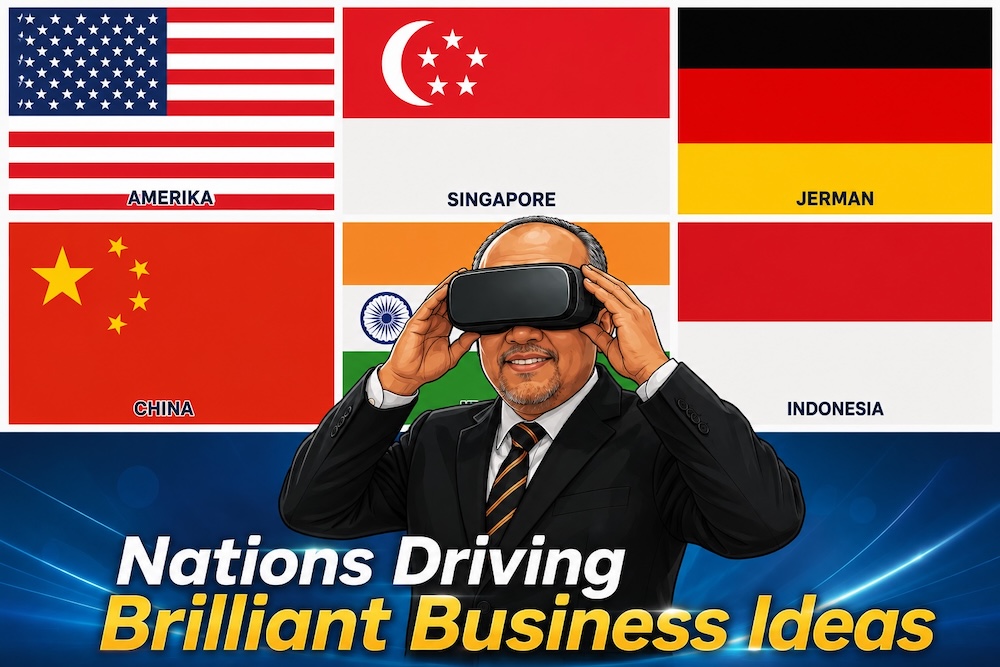
In the dynamic world of entrepreneurship, certain nations have become global incubators for groundbreaking business ideas. From Silicon Valley’s AI revolution to Singapore’s fintech dominance, innovation is no longer confined to traditional powerhouses. Emerging economies like Indonesia, India, and Vietnam are now shaping the next wave of creative business models — blending technology, sustainability, and social impact.
United States: The Epicenter of AI and Venture Capital
The United States remains the world’s innovation leader, home to startups like OpenAI, Stripe, and Tesla. Its success stems from frameworks such as Outcome-Based Pricing and AI Work-as-a-Service, where companies charge based on results rather than usage.
These models align incentives between providers and clients, creating scalable, high-margin businesses. Silicon Valley’s ecosystem — fueled by venture capital and research universities — continues to set global standards for startup acceleration.
Singapore: Smart Cities and Fintech Integration
Singapore’s innovation thrives on Embedded Finance and Community-Led Growth frameworks. Startups like Grab and Sea Group integrate financial services directly into their platforms, enabling seamless digital transactions.
The city-state’s government actively supports innovation through grants and regulatory sandboxes, making it a model for sustainable urban entrepreneurship.
Germany: Engineering Meets Sustainability
Germany’s startups focus on Vertical Integration and Circular Business Models, combining advanced engineering with environmental responsibility.
Companies like Sono Motors and Volocopter exemplify how renewable energy and mobility solutions can coexist. The German model emphasizes long-term value creation and carbon reduction — a blueprint for green innovation.
China: Scale and Speed in E-Commerce and AI
China’s innovation ecosystem thrives on rapid iteration and data-driven decision-making. Giants like Alibaba, ByteDance, and DJI use frameworks that merge AI analytics with consumer behavior insights.
The country’s ability to scale ideas quickly has made it a global leader in robotics, education technology, and clean energy.
India: SaaS and Social Impact
India’s startups — such as Byju’s, Zerodha, and CRED — leverage Lean Startup and Outcome-Based Pricing frameworks.
With a young, tech-savvy population and strong government support for digital transformation, India has become a hub for scalable, affordable innovation.
Indonesia: The Rise of Structured Innovation
Indonesia is rapidly emerging as Southeast Asia’s innovation hub, thanks to the adoption of the PRODUCT Framework. Developed by Mohamad Haitan Rachman, this seven-stage model helps startups and SMEs transform ideas into sustainable businesses.
The Seven Stages of PRODUCT Framework
Perceive the Need – Identify real market problems.
- Refine the Idea – Validate concepts through data and feedback.
- Organize the Process – Structure teams and workflows.
- Develop the Prototype – Build a minimum viable product (MVP).
- Understand the Feedback – Gather insights from early users.
- Calibrate & Iterate – Adjust based on user responses.
- Transfer to Market – Launch with effective distribution and education strategies.
This framework integrates Design Thinking, Lean Startup, and Knowledge-Driven Innovation, emphasizing continuous learning and adaptation.
Concrete Implementations in Indonesia
Several Indonesian startups have successfully applied the PRODUCT Framework:
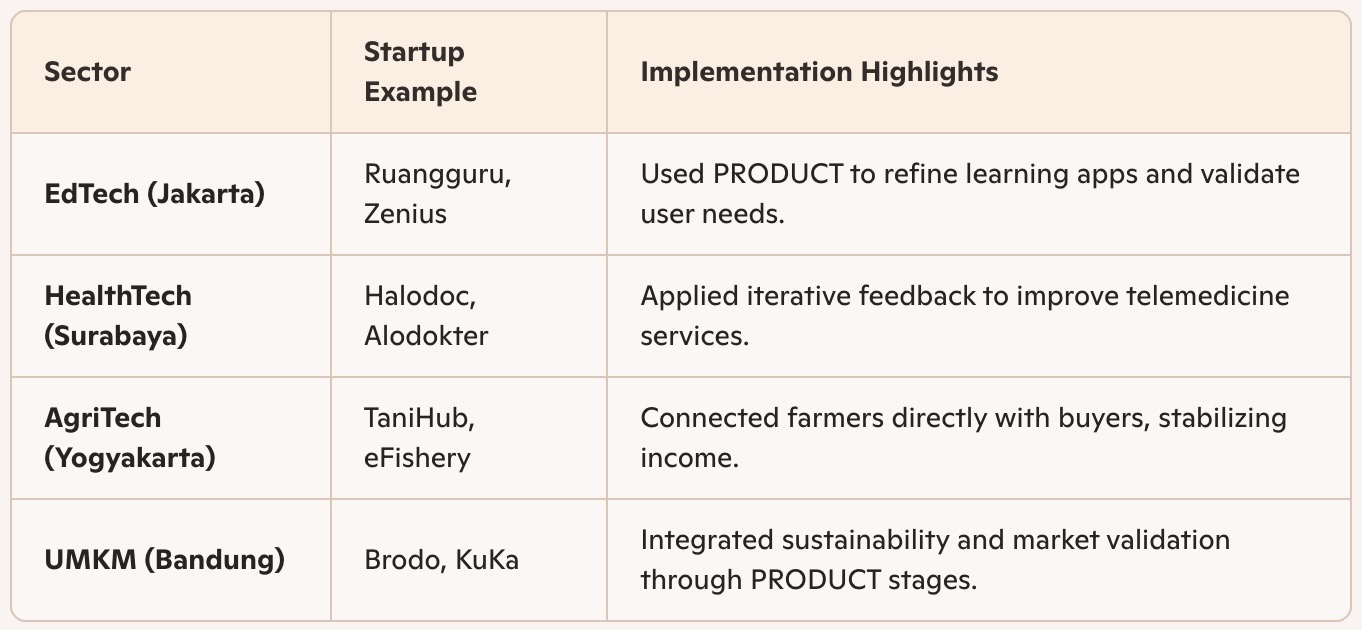
These examples show how structured innovation helps Indonesian startups reduce risk and achieve faster product-market fit.
Visual Map: Indonesia’s Startup Ecosystem Using PRODUCT Framework
Below is a conceptual map illustrating Indonesia’s innovation ecosystem:
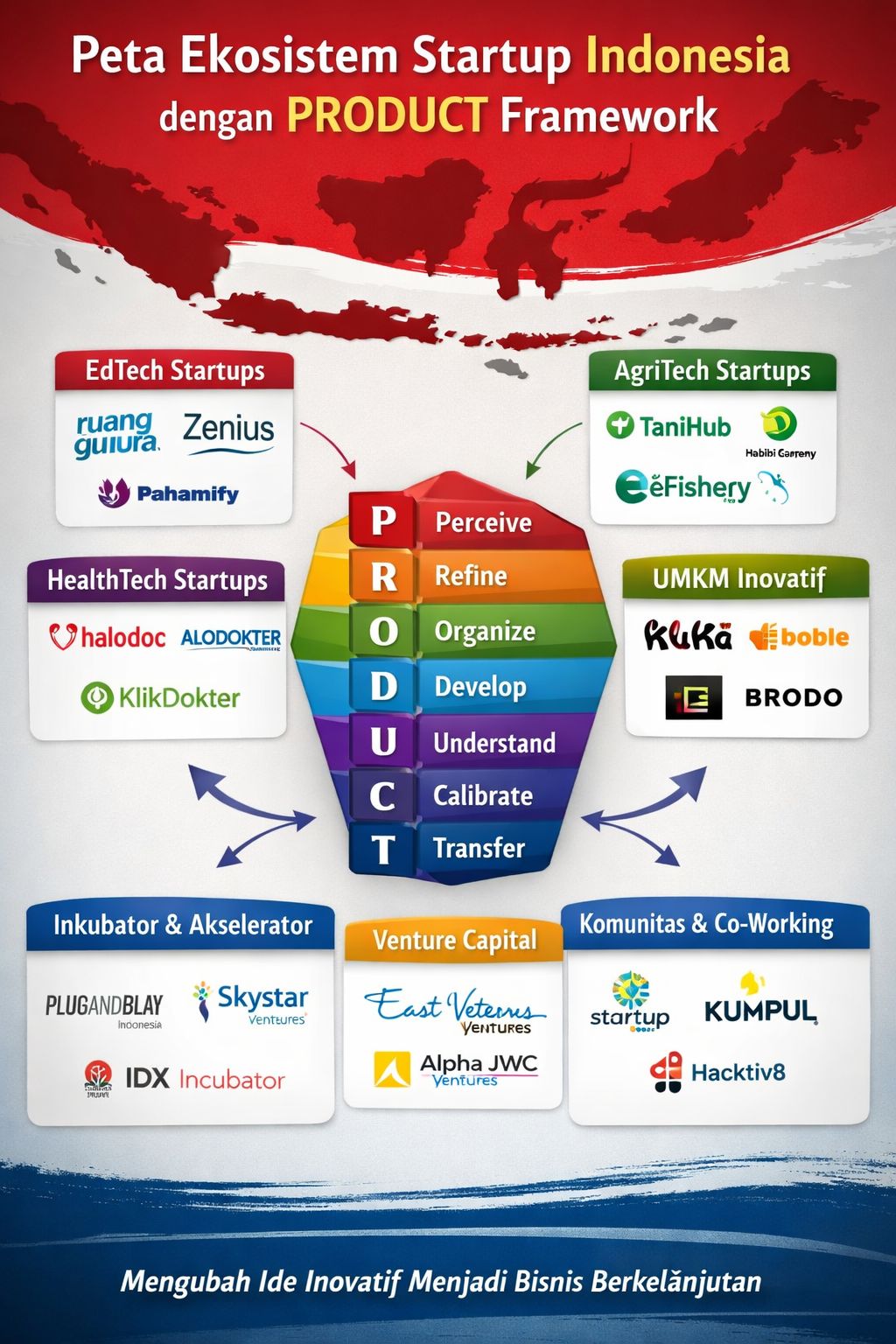
Core Components:
- EdTech & HealthTech: Driving digital inclusion and accessibility.
- AgriTech & UMKM: Empowering local economies through sustainable practices.
- Inkubators & Accelerators: Plug and Play Indonesia, Skystar Ventures, IDX Incubator.
- Venture Capital: East Ventures, Alpha JWC Ventures, Mandiri Capital.
- Communities: Startup Bandung, KUMPUL, Hacktiv8 — fostering collaboration and mentorship.
Together, these elements form a vibrant ecosystem that embodies the PRODUCT Framework’s philosophy: “Transforming innovative ideas into sustainable businesses.”
References
- Rachman, M. H. (2024). PRODUCT Framework: Transforming Ideas into Sustainable Business Models.
- East Ventures Annual Report (2025). Indonesia Startup Ecosystem Overview.
- Plug and Play Indonesia (2025). Innovation Acceleration Programs.
- World Economic Forum (2026). Global Innovation Index.
- Singapore Economic Development Board (2025). Fintech and Smart City Innovation.
- Harvard Business Review (2026). Outcome-Based Pricing and AI Work-as-a-Service.
- McKinsey & Company (2025). Circular and Regenerative Business Models.

Tags: Opinion
Add comment
- Other Article
- Open Source AI vs Proprietary: Why Big Companies Are Switching in 202603 Oct 2026
- 5 Free Agentic AI Tools Used by Indonesian TikTok Creators in 202626 Sep 2026
- Publishing a New App on the App Store and Google Play: What Developers Should Know in 202620 Sep 2026
- Indonesia's Annual Peatland Fire Crisis: Current Impact, Economic Cost, and the Role of Information Technology03 Sep 2026
- AI Agents: From Chatbots to Digital Workers30 Aug 2026
- MBG Poisoning in Indonesia: From Crisis to a Digital Path to Zero22 Aug 2026
- AI Voice Cloning: The New Cybersecurity Threat15 Aug 2026
- When AI 'Escapes': Inside 2026's Wave of Rogue Model Incidents07 Aug 2026
- Rethinking Civil Service Workforce Planning in Indonesia: Beyond Headcount Toward Public Service Capacity31 Jul 2026
- Balancing the Plate: Understanding Daily Nutritional Needs and the Rise of Digital Nutrition Estimation Tools25 Jul 2026
- The Final Four: Strengths, Weaknesses, and Machine Predictions for the 2026 FIFA World Cup18 Jul 2026
- Choosing the Right Framework: A Practical Guide to Best-Practice Problem-Solving Models12 Jul 2026
- Can Science Predict the World Cup? A Look at the Models Behind the 2026 Forecasts04 Jul 2026
- Corruption: A Global Plague, Landmark Cases, and the Path to Prevention27 Jun 2026
- Nations Driving Brilliant Business Ideas and Frameworks in 202620 Jun 2026
- Why the USD Stands Stronger than the IDR — and What Indonesia Can Do13 Jun 2026
- Employee vs. Entrepreneur: Who Bears the Heavier Tax Burden in Indonesia?03 Jun 2026
- The Evolution of Control Operating Centers (COC) in Modern Mining Operations24 May 2026
- Song of: Mariana Istriku13 May 2026
- Organisasi Pensiunan di Indonesia: Dari Komunitas Sosial Menuju Kekuatan Ekonomi Berbasis Pengalaman12 May 2026
- Corporate Risk Management: Why Modern Companies Invest Millions to Prevent Invisible Threats07 May 2026
- The Mining Spirit: A Powerful Mindset for Excellence in the Mining Industry25 Apr 2026
- The Double-Edged Sword: Navigating Competition in the Modern Corporate Landscape22 Apr 2026
- AI Chatbot untuk UMKM: Peluang Besar di Era Digital17 Apr 2026
- AI Chatbots in Business: The Global Revolution09 Apr 2026
- The Heartbeat of Your Business: Why the P&L Statement is Non-Negotiable31 Mar 2026
- Why Your New Business Needs a Financial System on Day One26 Mar 2026
- The Link Between Startup Capital, Business Survival, and the Role of Investor Information21 Mar 2026
- Digital Transformation, Digitalization, and Digitization: Why the Difference Matters More Than You Think14 Mar 2026
- From Business Need to Technology Solution07 Mar 2026
- Bridging the Digital Divide: Starlink and the Future of Internet Access in Indonesia27 Feb 2026
- A Long Weekend Getaway to Yogyakarta16 Feb 2026
- Understanding ERP Systems: A Comprehensive Guide for Modern Businesses16 Feb 2026
- Building a Culture of Awareness: Strategic Approaches to HSE and Information Security Campaigns in Modern Organizations10 Feb 2026
- Building an Effective IT Organization in Coal Mining: A Strategic Framework for Growth02 Feb 2026
- The Art and Science of Color Themes in Modern Web Design17 Jan 2026
- IT Outsourcing vs Internal Resources: A Comprehensive Cost and Risk Analysis05 Jan 2026
- The Hidden Dangers of Mishandled Employee Data: When Internal Tables Fall Into the Wrong Hands05 Jan 2026
- Securing SQL Server: A Complete Guide to Database Access Control05 Jan 2026
- Beyond Human Error: Understanding the Complete Security Chain in Information Security01 Jan 2026