Article
The Final Four: Strengths, Weaknesses, and Machine Predictions for the 2026 FIFA World Cup
Author: Agus Budi Harto, 2026-07-18 11:26:40
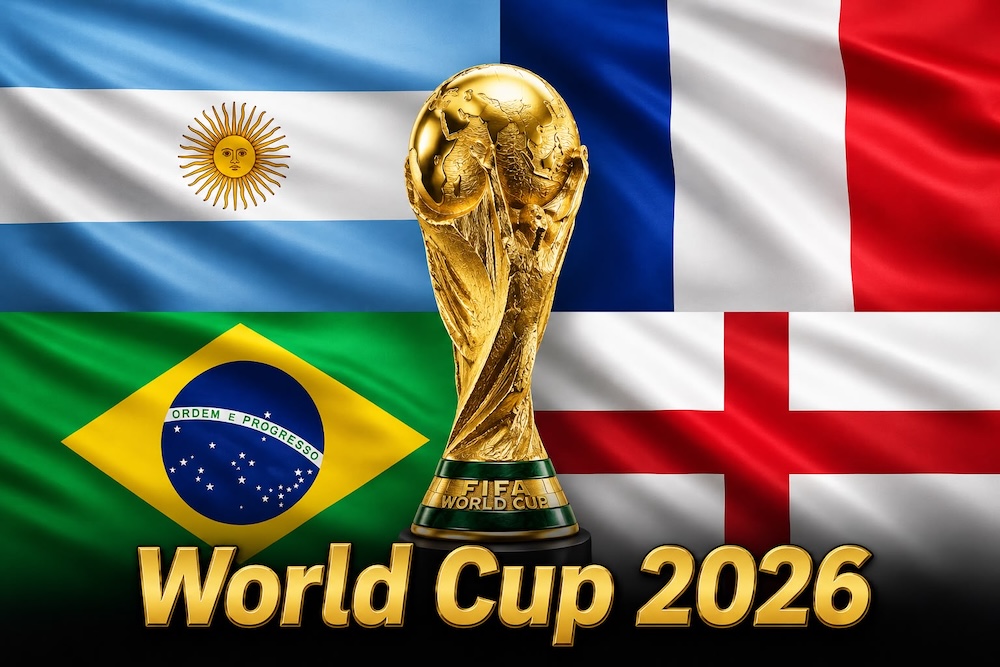
The 2026 FIFA World Cup, hosted across the United States, Canada, and Mexico, has reached its climactic stage. Of the record 48 teams that began the tournament, only four former world champions remain in contention for glory: Argentina, Spain, England, and France. Each of these nations carries a distinct footballing identity, shaped by different tactical philosophies, generational talent, and tournament experiences. As the football world turns its attention to the final stretch — the third-place playoff between France and England on July 19, and the grand final between Spain and Argentina on July 20 — it is worth examining what has carried each of these teams this far, where their vulnerabilities lie, and what the leading predictive models suggest about who will ultimately lift the trophy.
Argentina: The Defending Champions Chasing History
Argentina arrived in this tournament as reigning world champions, seeking to become back-to-back winners for the first time since Brazil accomplished the feat in 1962. Their campaign has been defined by an unshakeable competitive spirit and a level of individual brilliance that few nations in the world can match. At the heart of it all remains Lionel Messi, now well into the twilight of his international career but still capable of decisive moments on the largest stage. Around him, Argentina boasts a genuinely fearsome strike partnership in Julián Álvarez and Lautaro Martínez, both of whom have proven capable of stepping up when the team needed a breakthrough. This depth in attack gives head coach Lionel Scaloni multiple ways to hurt opponents, whether through Messi's vision and precision, Martínez's clinical finishing, or Álvarez's tireless movement.
Perhaps Argentina's greatest asset this tournament has been mentality. Time and again, La Albiceleste have found themselves in difficult positions during matches, only to respond with composure and resolve rather than panic. Their semifinal victory over England was emblematic of this trait: after falling behind, Argentina fought back to win 2-1 through late goals from Enzo Fernández and Lautaro Martínez, continuing a pattern of dramatic, character-driven wins that has become their calling card under Scaloni.
However, the same squad that carries so much winning experience is also showing signs of age-related strain. Messi and veteran defender Nicolás Otamendi are both 38 years old, and several other key contributors are approaching the tail end of their international careers. This raises legitimate questions about physical durability across a demanding, expanded 48-team tournament format that places extra strain on aging legs. Just as concerning has been the form of goalkeeper Emiliano Martínez, whose save percentage during the World Cup has dropped sharply to just 57.14 percent, a significant decline compared to his 70.7 percent save rate in the Premier League. For a team that has often relied on moments of goalkeeping heroics in high-stakes knockout football, this dip in reliability between the posts represents a real point of vulnerability heading into the final.
Spain: The Model of Modern Collective Football
If Argentina's story this tournament has been about individual brilliance and resilience, Spain's has been about system, structure, and remarkable defensive discipline. Under head coach Luis de la Fuente, Spain has built one of the most cohesive and tactically mature sides in the competition. Their defining statistic says it all: across their last five knockout and group-stage matches, La Roja have conceded only a single goal, an extraordinary level of defensive solidity for a team also known for its possession-based, front-foot style of play.
Spain's success is built on more than just defensive organization. Their squad blends experienced figures like Rodri and Pedri, both playing with composure and control in midfield, with a wave of exciting young talent, most notably Lamine Yamal, whose emergence has added a new attacking dimension to the team. This combination of continuity and fresh energy has given Spain a squad depth that many rivals simply cannot match, allowing De la Fuente to rotate without significantly weakening the team's overall quality. Their semifinal demolition of France, a comprehensive 2-0 victory, underlined just how well-drilled and confident this Spanish side has become.
Yet for all their defensive excellence, Spain's profile is not without a notable weakness: a lack of ruthlessness in front of goal. Several of their victories throughout the tournament have come by narrow margins despite periods of clear territorial and statistical dominance, suggesting that their chance conversion has lagged behind their overall control of matches. In a final against an Argentina side capable of scoring from limited opportunities, this inefficiency in the final third could prove costly if Spain fails to convert its share of the chances it is likely to create.
England: Mental Toughness Undermined by Defensive Fragility
England's run to the semifinals marked their fourth appearance at this stage of a World Cup, following previous semifinal appearances in 1966, 1990, and 2018. Under head coach Thomas Tuchel, this England side has repeatedly demonstrated an ability to fight back from difficult situations rather than wilt under pressure, a trait that has not always been associated with English sides at major tournaments. Much of their attacking output has flowed through Jude Bellingham and Harry Kane, who have each contributed six goals during the tournament, forming the backbone of England's offensive production.
Despite these attacking strengths and evident mental resilience, England's tournament has been undermined by defensive inconsistency. The team has already conceded six goals across the competition and has repeatedly given opposing sides clear opportunities, a pattern that ultimately proved decisive in their semifinal elimination. Their 2-1 defeat to Argentina followed a familiar script: England took an early second-half lead through Anthony Gordon, only to concede twice in the final stages of the match, first to Enzo Fernández and then to a stoppage-time winner from Lautaro Martínez. This tendency to lose control of matches late on, even after building a lead, remains England's central footballing problem, and it is one that overshadowed the genuine quality of their attacking talent throughout the tournament.
France: Consistency Without a Clear Cutting Edge
Of the four semifinalists, France was widely regarded by analysts and predictive models as the most consistently strong team for much of the tournament, having topped supercomputer rankings for the title on multiple occasions during the group and knockout stages. Their squad depth, tactical experience under a seasoned coaching setup, and overall balance across the pitch made them one of the most feared sides heading into the latter stages of the competition.
That consistency, however, did not translate into success against Spain in the semifinal, where France's attack was largely neutralized by a well-organized Spanish midfield and defense, resulting in a 2-0 defeat. The result exposed a recurring theme in France's tournament: an inability to consistently break down highly disciplined, possession-dominant opponents. While France's overall balance across the tournament was a clear strength, their semifinal exit suggests that when faced with a team executing a well-drilled defensive and possession strategy at the highest level, their attacking solutions were comparatively limited on the day.
What the Predictive Models Say
Football analytics firms and simulation-based models have played an increasingly prominent role in shaping pre-match narratives throughout this World Cup, and their outputs have shifted considerably as the tournament progressed. Opta's supercomputer, which bases its projections on thousands of simulated match scenarios incorporating team strength, current form, and bracket pathways, initially favored France as tournament favorites during the round-of-16 and quarterfinal stages, at one point giving Les Bleus title odds close to 30 percent. Argentina and Spain consistently occupied the second and third positions in these earlier simulations, while England's odds fluctuated depending on their results.
Following the conclusion of the semifinals, Opta's model was updated to reflect the new reality of a Spain-Argentina final. According to the most recent simulation, run across 10,000 scenarios, Spain now holds a 56.31 percent probability of winning the tournament, with Argentina given a 43.69 percent chance. This represents a meaningful shift in favor of Spain, driven largely by their defensive record and control-based playing style throughout the knockout stages. Separately, the analytics outlet Sportsmole produced its own projection favoring Spain by a smaller margin, at 44 percent to 32.85 percent, reflecting a similar directional consensus even if the exact magnitude differs between models.
For the third-place outcome, no major predictive model has published a definitive percentage breakdown for the England-France playoff at the time of writing, largely because this fixture typically receives less analytical attention than the final itself. However, based on underlying form data, France's stronger overall tournament consistency and defensive record stand in contrast to England's leakier defense, suggesting the two sides are closely matched heading into their meeting in Miami.
A Necessary Caveat
It is important to stress that these figures are statistical projections, not certainties. Supercomputer models like Opta's are built on historical data, current squad form, and probabilistic simulation, and while they have proven reasonably accurate at predicting group-stage outcomes and overall tournament trajectories, knockout football at the World Cup level is notoriously resistant to pure statistical prediction. Single-elimination matches are decided by moments, individual brilliance, refereeing decisions, and sometimes sheer luck, all of which are difficult for any model to fully capture. Spain entering the final as favorites reflects their sustained excellence across seven matches, but Argentina's tournament-long habit of prevailing in tight, high-pressure moments is precisely the kind of intangible factor that statistical models struggle to price in. As football's oldest cliché reminds us, the ball is round, and anything can happen once the whistle blows.
References
- BolaSkor.com. "Profil Semifinalis Piala Dunia 2026: Kekuatan, Kelemahan, dan Peluang Argentina, Inggris, Prancis, dan Spanyol." BolaSkor, July 2026.
- Jawa Pos. "Analisis Argentina di Piala Dunia 2026: Kekuatan Messi Cs dan Tantangan Menuju Back-to-Back." Jawa Pos, June 11, 2026.
- CNN Indonesia. "3 Kelemahan Argentina yang Bisa Jadi Senjata Inggris Lolos ke Final." CNN Indonesia, July 15, 2026.
- Kompas.com. "Rekap Hasil Semifinal Piala Dunia 2026: Argentina dan Spanyol Menang." Kompas.com, July 16, 2026.
- detikSport. "Prediksi Supercomputer: Spanyol Vs Argentina, Tim Matador Favorit Juara." detik.com, July 17, 2026.
- detik.com. "Spanyol Favorit Juara Piala Dunia 2026 Versi Opta." detik.com, July 15, 2026.
- Bangkapos.com. "Prediksi Skor Spanyol vs Argentina Final Piala Dunia 2026, Statistik Tim dan Line-Up Pemain." Bangkapos.com, July 17, 2026.
- Universitas Komputama Cilacap. "Prediksi Argentina vs Spanyol: Line Up, Statistik, Head to Head, Siapa Lebih Jago?" unikma.ac.id, July 17, 2026.
- IDN Times. "Bagan Terbaru Hasil Semifinal hingga Final Piala Dunia 2026." IDN Times, July 2026.
- Opta Analyst — official supercomputer simulation data, as cited across the above sources.
Note: All predictive percentages cited in this article reflect statistical simulations produced by third-party analytics models (primarily Opta Supercomputer and Sportsmole) as of July 17, 2026. These are probabilistic estimates, not guarantees of outcome, and are subject to change based on team news, injuries, and match conditions ahead of kickoff.*

Tags: Event
Add comment
- Other Article
- Open Source AI vs Proprietary: Why Big Companies Are Switching in 202603 Oct 2026
- 5 Free Agentic AI Tools Used by Indonesian TikTok Creators in 202626 Sep 2026
- Publishing a New App on the App Store and Google Play: What Developers Should Know in 202620 Sep 2026
- Indonesia's Annual Peatland Fire Crisis: Current Impact, Economic Cost, and the Role of Information Technology03 Sep 2026
- AI Agents: From Chatbots to Digital Workers30 Aug 2026
- MBG Poisoning in Indonesia: From Crisis to a Digital Path to Zero22 Aug 2026
- AI Voice Cloning: The New Cybersecurity Threat15 Aug 2026
- When AI 'Escapes': Inside 2026's Wave of Rogue Model Incidents07 Aug 2026
- Rethinking Civil Service Workforce Planning in Indonesia: Beyond Headcount Toward Public Service Capacity31 Jul 2026
- Balancing the Plate: Understanding Daily Nutritional Needs and the Rise of Digital Nutrition Estimation Tools25 Jul 2026
- The Final Four: Strengths, Weaknesses, and Machine Predictions for the 2026 FIFA World Cup18 Jul 2026
- Choosing the Right Framework: A Practical Guide to Best-Practice Problem-Solving Models12 Jul 2026
- Can Science Predict the World Cup? A Look at the Models Behind the 2026 Forecasts04 Jul 2026
- Corruption: A Global Plague, Landmark Cases, and the Path to Prevention27 Jun 2026
- Nations Driving Brilliant Business Ideas and Frameworks in 202620 Jun 2026
- Why the USD Stands Stronger than the IDR — and What Indonesia Can Do13 Jun 2026
- Employee vs. Entrepreneur: Who Bears the Heavier Tax Burden in Indonesia?03 Jun 2026
- The Evolution of Control Operating Centers (COC) in Modern Mining Operations24 May 2026
- Song of: Mariana Istriku13 May 2026
- Organisasi Pensiunan di Indonesia: Dari Komunitas Sosial Menuju Kekuatan Ekonomi Berbasis Pengalaman12 May 2026
- Corporate Risk Management: Why Modern Companies Invest Millions to Prevent Invisible Threats07 May 2026
- The Mining Spirit: A Powerful Mindset for Excellence in the Mining Industry25 Apr 2026
- The Double-Edged Sword: Navigating Competition in the Modern Corporate Landscape22 Apr 2026
- AI Chatbot untuk UMKM: Peluang Besar di Era Digital17 Apr 2026
- AI Chatbots in Business: The Global Revolution09 Apr 2026
- The Heartbeat of Your Business: Why the P&L Statement is Non-Negotiable31 Mar 2026
- Why Your New Business Needs a Financial System on Day One26 Mar 2026
- The Link Between Startup Capital, Business Survival, and the Role of Investor Information21 Mar 2026
- Digital Transformation, Digitalization, and Digitization: Why the Difference Matters More Than You Think14 Mar 2026
- From Business Need to Technology Solution07 Mar 2026
- Bridging the Digital Divide: Starlink and the Future of Internet Access in Indonesia27 Feb 2026
- A Long Weekend Getaway to Yogyakarta16 Feb 2026
- Understanding ERP Systems: A Comprehensive Guide for Modern Businesses16 Feb 2026
- Building a Culture of Awareness: Strategic Approaches to HSE and Information Security Campaigns in Modern Organizations10 Feb 2026
- Building an Effective IT Organization in Coal Mining: A Strategic Framework for Growth02 Feb 2026
- The Art and Science of Color Themes in Modern Web Design17 Jan 2026
- IT Outsourcing vs Internal Resources: A Comprehensive Cost and Risk Analysis05 Jan 2026
- The Hidden Dangers of Mishandled Employee Data: When Internal Tables Fall Into the Wrong Hands05 Jan 2026
- Securing SQL Server: A Complete Guide to Database Access Control05 Jan 2026
- Beyond Human Error: Understanding the Complete Security Chain in Information Security01 Jan 2026