Article
Choosing the Right Framework: A Practical Guide to Best-Practice Problem-Solving Models
Author: Agus Budi Harto, 2026-07-12 10:08:02
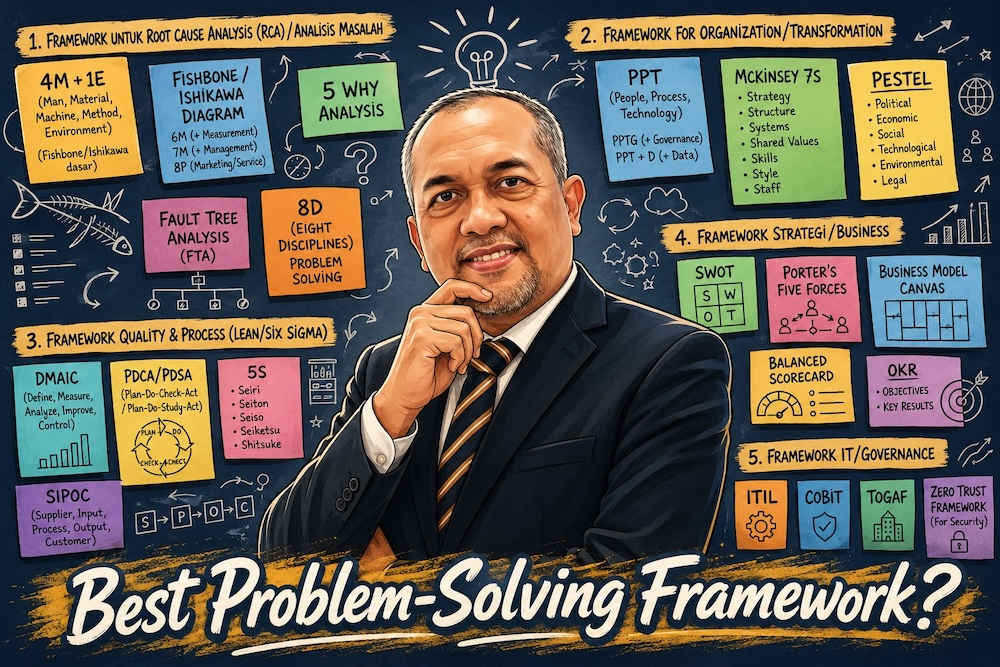
Every organization, at some point, reaches for a "framework" to make sense of a messy problem. Terms like PPT (People, Process, Technology), 4M+1E (Man, Material, Machine, Method, Environment), SWOT, DMAIC, and ITIL get thrown around in meeting rooms as if they were universally interchangeable tools. In reality, they are not. Each framework was born out of a specific discipline — manufacturing, IT governance, corporate strategy, or quality engineering — and each carries its own strengths, blind spots, and ideal use case. This article walks through five major families of best-practice frameworks, compares their strengths and weaknesses, cites the evidence on how widely each is actually used, and closes with a concrete case study: how a football club might combine several of these frameworks to chase sustained sporting success.
There Is No Single Universal Framework
A natural first question is simply: how many of these frameworks exist? The honest answer is that there is no fixed number. New variations are published constantly by consultants, academics, and industry bodies, and older frameworks are routinely adapted — 4M becomes 6M or 7M depending on the industry, PPT becomes PPTG with the addition of Governance, and so on. What can be said with more confidence is that these frameworks cluster into five broad families, each solving a different class of problem: root cause analysis, organizational transformation, process quality improvement, business strategy, and IT governance.
Five Families of Frameworks
Root Cause Analysis (RCA) tools — including 4M+1E, the Fishbone (Ishikawa) diagram, the 5 Whys, Fault Tree Analysis, and 8D — exist to trace a symptom back to its underlying cause. Their greatest strength is accessibility: a shop-floor operator and a plant manager can sit at the same table and build a Fishbone diagram together without needing statistical training. Kaoru Ishikawa first introduced the cause-and-effect diagram in 1968 as part of his broader work on quality control, and it remains one of the seven basic quality tools taught in manufacturing and Lean Six Sigma programs today. The weakness of this family is that it is fundamentally diagnostic rather than corrective — it tells you what went wrong, but implementing a fix is left to a separate step, and the diagnosis itself depends heavily on the knowledge and biases of whoever is in the room.
Organizational and transformation frameworks — PPT (People, Process, Technology), McKinsey's 7S model, and PESTEL — take a step back and examine a problem systemically. PPT is particularly popular in IT service management and digital transformation projects because it captures three levers that must move together: the people who do the work, the processes they follow, and the technology that supports them. McKinsey's 7S, introduced by Peters and Waterman in their 1982 book In Search of Excellence, expands this into seven interlocking elements (Strategy, Structure, Systems, Shared Values, Skills, Style, Staff) and is often used to check whether an organization's internal elements are aligned before a change initiative is launched. The trade-off with this family is that it operates at a fairly abstract, strategic altitude — useful for spotting misalignment, but not detailed enough to fix a specific technical defect on its own.
Lean and Six Sigma frameworks — PDCA (Plan-Do-Check-Act), DMAIC (Define-Measure-Analyze-Improve-Control), 5S, and SIPOC — are built for continuous, measurable process improvement. PDCA traces back to Walter Shewhart's statistical process control work and was later popularized by W. Edwards Deming; DMAIC was developed by Motorola and refined by General Electric in the 1980s and 1990s as the backbone of Six Sigma. Both frameworks share a cyclical, data-driven structure that makes improvements sustainable rather than one-off, but that same rigor is also their limitation: DMAIC in particular requires statistical competence and more time investment than a team may have for a fast-moving problem.
Business strategy frameworks — SWOT, Porter's Five Forces, the Business Model Canvas, the Balanced Scorecard, and OKRs — operate at the level of corporate direction and competitive positioning. Porter's Five Forces, from his 1980 book Competitive Strategy, remains a standard lens for assessing industry attractiveness, while the Balanced Scorecard, introduced by Kaplan and Norton in 1992, extended strategic measurement beyond pure financial metrics into customer, internal-process, and learning-and-growth perspectives. These tools are indispensable for long-term planning but are generally the wrong instrument for diagnosing a specific operational failure on the factory floor.
IT governance frameworks — ITIL, COBIT, and TOGAF — bring structure to how technology is managed, delivered, and architected at scale. ITIL focuses on the IT service lifecycle, COBIT (developed by ISACA) governs risk, compliance, and control objectives, and TOGAF (from The Open Group) provides a structured methodology for enterprise architecture through its Architecture Development Method. These frameworks are the industry standard for large organizations that must satisfy audit, compliance, and regulatory requirements, but their comprehensiveness comes at a cost: implementation is complex, often requires formal certification, and can be disproportionately heavy for a small organization.
How Widely Is Each Framework Actually Used?
Popularity is hard to measure precisely, but some data exists — and it is more solid in some categories than others. In business strategy, Bain & Company's long-running Management Tools & Trends survey offers the clearest quantitative picture: across its 2017 edition, Strategic Planning topped the list at 48% usage, tied closely with Customer Relationship Management at 48%, followed by Benchmarking at 46% and Advanced Analytics at 42%. The Balanced Scorecard, despite its academic prominence, sat further down the list at 29% usage. Interestingly, the same survey found that average tool usage per company has been declining for years — from a peak of over 16 tools per company in 2002 down to roughly 7.5 tools by 2017 — suggesting organizations have become more selective rather than more tool-hungry over time.
In IT governance, the numbers are striking in absolute terms. ISACA reports that COBIT has been adopted by roughly 170,000 organizations worldwide, while The Open Group counts more than 870 member organizations actively using TOGAF. ITIL does not have an equivalent global adoption figure, but it counts marquee adopters such as NASA, the UK's National Health Service, and Disney. In practice, industry commentary consistently notes that these three frameworks are rarely used as rivals — they are frequently deployed together, with COBIT handling governance and risk, ITIL handling service delivery, and TOGAF handling architecture.
For root cause analysis, no single global adoption survey exists, but industry usage patterns are well documented qualitatively. The Fishbone diagram and the 5 Whys are consistently identified as the two most commonly reached-for tools, with the choice between them typically driven by problem complexity: the 5 Whys suits a direct, linear issue, while the Fishbone diagram is preferred when a problem has many interacting contributing factors. Category variants also differ by sector — manufacturing environments tend to favor an extended 6M model (Material, Machine, Method, Manpower, Measurement, Management), while service industries more often use a 4S model (Supplies, Surroundings, Systems, Skills).
The organizational-transformation family (PPT, 7S) and the Lean/Six Sigma family (PDCA, DMAIC) lack dedicated global usage surveys altogether. What can be said is that PDCA functions as something close to a universal substrate — it underlies many other quality tools, including the Fishbone diagram itself — while DMAIC is reserved for more formal, large-scale Six Sigma initiatives given its heavier statistical demands.
No Single "Best" Framework — Only Best Fit
Given this landscape, asking which framework is unconditionally superior is the wrong question. It is closer to asking which medicine is best without first naming the illness. A more useful approach is to match the framework to the nature of the problem: root cause tools for a recurring technical defect, PDCA or DMAIC for a process that needs sustained measurable improvement, PPT or 7S for an organizational transformation, strategy tools for long-term competitive positioning, and IT governance frameworks for large-scale technology and compliance management. Frequently, the most effective real-world solutions combine two or three of these families rather than relying on just one.
Case Study: Applying the Frameworks to a Football Club's Pursuit of Excellence
A useful test of this multi-framework thinking is a domain far removed from factories and IT departments: a football club trying to achieve sustained sporting success. "Performing at the highest level" is not a single, diagnosable problem — it is a systemic, long-term objective touching player quality, tactics, club management, finances, mentality, and infrastructure simultaneously. Reaching for just one framework produces a lopsided view; a SWOT analysis alone, for instance, might describe a club's overall competitive position without ever explaining why the team concedes goals late in matches.
A layered approach maps naturally onto the five framework families discussed above. At the top, a Balanced Scorecard can translate the club's long-term ambition — winning the league, qualifying for European competition, developing a strong academy — into measurable targets across four perspectives: financial (wage bill, transfer spending), fan/customer engagement, internal processes (tactical systems, training methodology), and learning and growth (youth development, coaching pipeline). Beneath that strategic layer, PPT (People, Process, Technology) offers a natural operating structure for the club as a whole: People covers the players, coaching staff, squad depth, and dressing-room leadership; Process covers tactical philosophy, training methodology, fitness periodization, and scouting systems; and Technology covers the data analytics, video analysis, and sports-science tools that top clubs now rely on heavily. At the operational level, the PDCA cycle mirrors almost exactly how elite coaching staffs already work: Plan the tactical approach for a match, Do it on the pitch, Check the result and performance data afterward, and Act on those findings in the next training cycle. Finally, when a specific and recurring issue appears — a tendency to concede in the second half, or a persistent problem with finishing — Fishbone diagrams or the 5 Whys provide the right level of granularity to trace that symptom back to its actual cause, whether it is fitness, tactical shape, or decision-making under fatigue.
None of Europe's top-performing clubs necessarily uses this exact vocabulary internally, but the pattern is visible in how leading organizations operate: dedicated data-science and sports-science divisions functioning as the Technology pillar, a consistent playing philosophy carried from academy to first team functioning as the Process pillar, and a long-term measurement structure spanning finances, fan engagement, and player development functioning as a Balanced Scorecard in practice, even if it is never formally labeled as one.
Conclusion
Best-practice frameworks are not a single ranked list with one winner at the top — they are a toolbox assembled from decades of separate disciplines, each optimized for a different kind of problem. The evidence available, from Bain's decades of strategy-tool surveys to ISACA's adoption figures for COBIT, shows that popularity itself varies enormously by category and by region, and that the most mature organizations tend to use fewer, better-chosen tools rather than more. The lesson, whether applied to a factory floor, an IT department, or a football club chasing a championship, is the same: start by naming the actual problem, then select — and combine — the framework whose structure fits that problem, rather than forcing every situation into a single favorite model.
References
- Ishikawa, K. (1968). Guide to Quality Control. Asian Productivity Organization.
- Peters, T. J., & Waterman, R. H. (1982). In Search of Excellence: Lessons from America's Best-Run Companies. Harper & Row. (Origin of the McKinsey 7S Framework)
- Porter, M. E. (1980). Competitive Strategy: Techniques for Analyzing Industries and Competitors. Free Press. (Origin of the Five Forces Framework)
- Kaplan, R. S., & Norton, D. P. (1992). "The Balanced Scorecard—Measures That Drive Performance." Harvard Business Review.
- Rigby, D., & Bilodeau, B. Management Tools & Trends. Bain & Company. Retrieved from bain.com/insights/management-tools-and-trends-2017 and the Bain Top Ten Tools interactive chart (media.bain.com/management_tools/baintoptentools/2017/).
- ISACA. COBIT Framework adoption data. Referenced via The Knowledge Academy, "ITIL vs. COBIT vs. TOGAF: Detailed Comparison," theknowledgeacademy.com.
- The Open Group. TOGAF Standard membership data. Referenced via the same comparative source above.
- AXELOS / PeopleCert. ITIL Framework case studies (NASA, NHS, Disney). Referenced via UpGuard, "COBIT vs ITIL vs TOGAF: Which Is Better for Cybersecurity?," upguard.com (2025).
- KnowledgeHut. "COBIT vs TOGAF – Which One Is Better?" knowledgehut.com (2026). (95% enterprise IT-governance framework adoption figure)
- Nexus Global. "The 3 Most Popular RCA Tools." blog.nexusglobal.com (2025).
- LearnLeanSigma. "Fishbone Diagram or 5 Whys Analysis: Which Should You Use?" learnleansigma.com (2024).
- Asana. "7 Process Improvement Methodologies to Improve Efficiency." asana.com/resources (2026).
- Deming, W. E. — popularizer of the Plan-Do-Check-Act (PDCA) cycle, building on Walter A. Shewhart's statistical process control work.
- Motorola / General Electric — originators and popularizers of the DMAIC methodology within Six Sigma (1980s–1990s).

Add comment
- Other Article
- Passkeys Replacing Passwords: The Future of Secure Digital Authentication23 Oct 2026
- Counterfeit Money in Indonesia: A Persistent Threat to Public Trust and How to Fight It14 Oct 2026
- Google NotebookLM Audio Overview: How Your Boring Documents Became an Addictive Automatic Podcast10 Oct 2026
- Open Source AI vs Proprietary: Why Big Companies Are Switching in 202603 Oct 2026
- 5 Free Agentic AI Tools Used by Indonesian TikTok Creators in 202626 Sep 2026
- Publishing a New App on the App Store and Google Play: What Developers Should Know in 202620 Sep 2026
- Indonesia's Annual Peatland Fire Crisis: Current Impact, Economic Cost, and the Role of Information Technology03 Sep 2026
- AI Agents: From Chatbots to Digital Workers30 Aug 2026
- MBG Poisoning in Indonesia: From Crisis to a Digital Path to Zero22 Aug 2026
- AI Voice Cloning: The New Cybersecurity Threat15 Aug 2026
- When AI 'Escapes': Inside 2026's Wave of Rogue Model Incidents07 Aug 2026
- Rethinking Civil Service Workforce Planning in Indonesia: Beyond Headcount Toward Public Service Capacity31 Jul 2026
- Balancing the Plate: Understanding Daily Nutritional Needs and the Rise of Digital Nutrition Estimation Tools25 Jul 2026
- The Final Four: Strengths, Weaknesses, and Machine Predictions for the 2026 FIFA World Cup18 Jul 2026
- Choosing the Right Framework: A Practical Guide to Best-Practice Problem-Solving Models12 Jul 2026
- Can Science Predict the World Cup? A Look at the Models Behind the 2026 Forecasts04 Jul 2026
- Corruption: A Global Plague, Landmark Cases, and the Path to Prevention27 Jun 2026
- Nations Driving Brilliant Business Ideas and Frameworks in 202620 Jun 2026
- Why the USD Stands Stronger than the IDR — and What Indonesia Can Do13 Jun 2026
- Employee vs. Entrepreneur: Who Bears the Heavier Tax Burden in Indonesia?03 Jun 2026
- The Evolution of Control Operating Centers (COC) in Modern Mining Operations24 May 2026
- Song of: Mariana Istriku13 May 2026
- Organisasi Pensiunan di Indonesia: Dari Komunitas Sosial Menuju Kekuatan Ekonomi Berbasis Pengalaman12 May 2026
- Corporate Risk Management: Why Modern Companies Invest Millions to Prevent Invisible Threats07 May 2026
- The Mining Spirit: A Powerful Mindset for Excellence in the Mining Industry25 Apr 2026
- The Double-Edged Sword: Navigating Competition in the Modern Corporate Landscape22 Apr 2026
- AI Chatbot untuk UMKM: Peluang Besar di Era Digital17 Apr 2026
- AI Chatbots in Business: The Global Revolution09 Apr 2026
- The Heartbeat of Your Business: Why the P&L Statement is Non-Negotiable31 Mar 2026
- Why Your New Business Needs a Financial System on Day One26 Mar 2026
- The Link Between Startup Capital, Business Survival, and the Role of Investor Information21 Mar 2026
- Digital Transformation, Digitalization, and Digitization: Why the Difference Matters More Than You Think14 Mar 2026
- From Business Need to Technology Solution07 Mar 2026
- Bridging the Digital Divide: Starlink and the Future of Internet Access in Indonesia27 Feb 2026
- A Long Weekend Getaway to Yogyakarta16 Feb 2026
- Understanding ERP Systems: A Comprehensive Guide for Modern Businesses16 Feb 2026
- Building a Culture of Awareness: Strategic Approaches to HSE and Information Security Campaigns in Modern Organizations10 Feb 2026
- Building an Effective IT Organization in Coal Mining: A Strategic Framework for Growth02 Feb 2026
- The Art and Science of Color Themes in Modern Web Design17 Jan 2026
- IT Outsourcing vs Internal Resources: A Comprehensive Cost and Risk Analysis05 Jan 2026
- The Hidden Dangers of Mishandled Employee Data: When Internal Tables Fall Into the Wrong Hands05 Jan 2026
- Securing SQL Server: A Complete Guide to Database Access Control05 Jan 2026
- Beyond Human Error: Understanding the Complete Security Chain in Information Security01 Jan 2026