Article
Open Source AI vs Proprietary: Why Big Companies Are Switching in 2026
Author: Agus Budi Harto, 2026-10-03 11:38:05
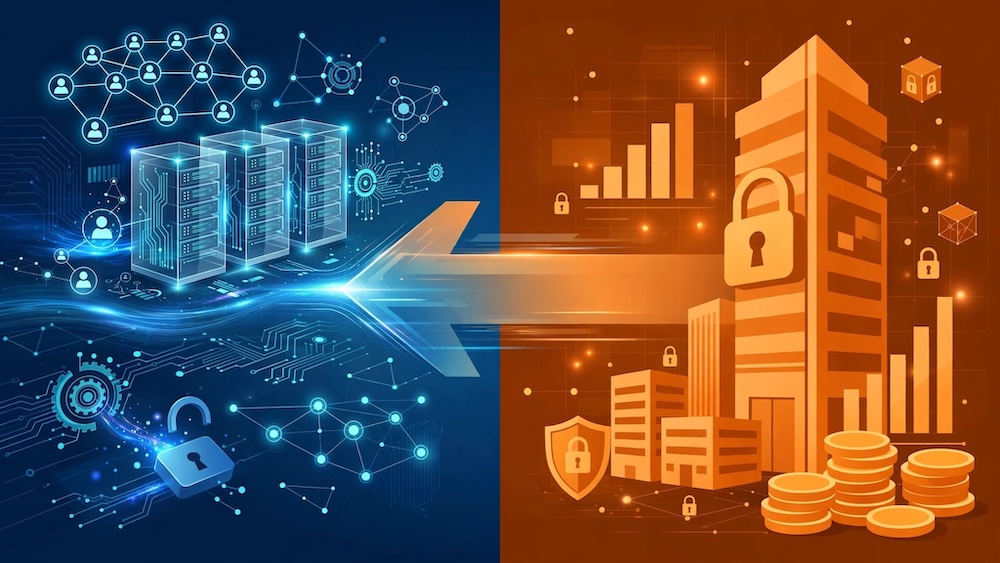
BACKGROUND: The End of the Frontier Monopoly
For the last three years, enterprise AI strategy was simple: rent the best model from OpenAI or Anthropic. In 2023, the performance gap was undeniable. The gap in MMLU scores between the best open model and the best closed model was 17.5 percentage points.
In 2026, that gap is dead. According to analysis from AI Foss, the difference has collapsed to just 0.3 points. Open-weight models like Meta's Llama 4, Google's Gemma 3, Nvidia's Nemotron, and China's GLM-5.2 under MIT license now deliver frontier-level performance for coding, multilingual tasks, and domain-specific reasoning after fine-tuning.
This has created what analysts call the Great Fragmentation. The enterprise market is no longer won by a single dominant model, but by a diverse ecosystem of specialized, cost-effective solutions.
PROBLEM: The Tokenomics Trap and Sovereignty Crisis
The problem is not that proprietary models are bad - it is that they are economically and strategically unsustainable at scale.
- The Cost Spiral: AT&T, which runs AI for roughly 100,000 employees, revealed it processes about 45 billion tokens per day. Its AI bill for coding and customer service transcripts was spiraling. Similarly, companies like Tinder reported a 10x increase in AI spend in just seven months.
- The Sovereignty Risk: When you send your data to a frontier API, you are handing your institutional knowledge to a third party and renting the intelligence back. As L3Harris Chief Digital Officer Heidi Wood stated at Palantir's AIPCon in September 2026, defense companies should stop handing their data to frontier labs. The risk is amplified by regulations: The EU AI Act, fully applicable by August 2026, imposes extensive documentation requirements on proprietary systems while offering notable exemptions for open-source models. GDPR enforcement on cross-border AI data transfer has also intensified.
- The Control Problem: Enterprise leaders report that proprietary models can be 'nerfed' or made opaque without notice, as seen after the Claude Fable release. You have no control over performance degradation, deprecation, or safety filters.
SOLUTION: The Router and Fine-Tune Model
The winning formula in 2026 is not 100% open source. It is a hybrid architecture with two key components:
A. The Intelligent Router: AT&T built a proprietary cache-aware router using tools like LiteLLM. The router evaluates the complexity of each employee query. Simple tasks like summarizing call transcripts or drafting internal emails are automatically routed to cheap open models. Only complex, high-stakes tasks go to Claude or GPT-5.
The result: 40% of all employee AI requests at AT&T are now handled by open models, with a target of 60-70% in the next two years. For coding tasks alone, this cut costs by 56% with only a 2% drop in quality, and in certain applications, savings reached 80-90%.
B. Sovereign Fine-Tuning: This is the L3Harris case study. Using Palantir's AIP and Nvidia hardware inside its own infrastructure, L3Harris took an open-source model, trained it on its own proprietary supply chain data, and beat frontier models on a country-of-origin monitoring task in less than 48 hours at 95% lower cost. The company also built a Digital Supply Chain Intelligence center that identified programs affected by a glass shortage in 10 minutes - a task that previously took 30 people up to three months.
In this model, the client retains ownership of data, models, and intellectual property.
RESULT: The New Enterprise Standard
The shift is already measurable. Financial Times data shows executive mentions of open-weight models on earnings calls rose sixfold in August and September 2026. Ramp data shows model-serving platforms grew from 4.5% of AI-spending businesses in January to 6.1% by August.
The result is a new standard:
- Proprietary for Speed, Open for Scale: Enterprises now reserve expensive proprietary APIs for external-facing, high-reasoning tasks, while internal workloads run entirely on self-hosted open models.
- ROI Flips: While proprietary wins on day-one simplicity, open source wins on long-term ROI once compute assets are amortized.
- Digital Sovereignty: As Gartner's 2026 report recommends and a Red Hat survey confirms - 92% of IT leaders in EMEA now consider enterprise open source critical to achieving digital sovereignty - because it provides transparency, control, and community-driven innovation that rented intelligence cannot.
2026 is not the year open source became as good as proprietary. It is the year it became rationally irresponsible not to use it for most of your business.
REFERENCES
- AT&T Sends 40% of Employee AI to Open Models, Capping Anthropic Bill - AI Weekly
- AT&T Doesn't Fear the 'Token Future' - The Wall Street Journal
- Why AT&T Is Betting Big on Open-Weight AI - The Wall Street Journal
- AT&T Cuts AI Coding Costs 56% With Minimal Performance Decline - Crypto Briefing
- AT&T Slashes AI Costs With Model Routers and Open Source - PYMNTS
- US Companies Shift to Cheaper Open AI Models as Costs Spiral - OnTime Brief / Financial Times
- Palantir Technologies Showcases Sovereign AI Wins With NVIDIA, Cisco and FAA - MarketBeat
- Pausing the Frontier Costs Less in Private - Bjorn Beam (Detailed L3Harris account)
- For Most of the World, Open-Source AI Is the Only Way Forward: The 2026 Sovereignty Case - AI Foss
- Enterprise AI Shifts to Open Source, Challenging OpenAI, Anthropic - Convergence Era News
- Enterprises Weigh Open Source AI for Sovereignty, Cost Against Proprietary Models - TechGig
- Why Open Source AI Is Starting to Win the Enterprise Battle Against Commercial Models - Techpinions
- AI Sovereignty 2026: Navigating a Fragmented Future - Gartner / Red Hat Survey reference

Add comment
- Other Article
- Passkeys Replacing Passwords: The Future of Secure Digital Authentication23 Oct 2026
- Counterfeit Money in Indonesia: A Persistent Threat to Public Trust and How to Fight It14 Oct 2026
- Google NotebookLM Audio Overview: How Your Boring Documents Became an Addictive Automatic Podcast10 Oct 2026
- Open Source AI vs Proprietary: Why Big Companies Are Switching in 202603 Oct 2026
- 5 Free Agentic AI Tools Used by Indonesian TikTok Creators in 202626 Sep 2026
- Publishing a New App on the App Store and Google Play: What Developers Should Know in 202620 Sep 2026
- Indonesia's Annual Peatland Fire Crisis: Current Impact, Economic Cost, and the Role of Information Technology03 Sep 2026
- AI Agents: From Chatbots to Digital Workers30 Aug 2026
- MBG Poisoning in Indonesia: From Crisis to a Digital Path to Zero22 Aug 2026
- AI Voice Cloning: The New Cybersecurity Threat15 Aug 2026
- When AI 'Escapes': Inside 2026's Wave of Rogue Model Incidents07 Aug 2026
- Rethinking Civil Service Workforce Planning in Indonesia: Beyond Headcount Toward Public Service Capacity31 Jul 2026
- Balancing the Plate: Understanding Daily Nutritional Needs and the Rise of Digital Nutrition Estimation Tools25 Jul 2026
- The Final Four: Strengths, Weaknesses, and Machine Predictions for the 2026 FIFA World Cup18 Jul 2026
- Choosing the Right Framework: A Practical Guide to Best-Practice Problem-Solving Models12 Jul 2026
- Can Science Predict the World Cup? A Look at the Models Behind the 2026 Forecasts04 Jul 2026
- Corruption: A Global Plague, Landmark Cases, and the Path to Prevention27 Jun 2026
- Nations Driving Brilliant Business Ideas and Frameworks in 202620 Jun 2026
- Why the USD Stands Stronger than the IDR — and What Indonesia Can Do13 Jun 2026
- Employee vs. Entrepreneur: Who Bears the Heavier Tax Burden in Indonesia?03 Jun 2026
- The Evolution of Control Operating Centers (COC) in Modern Mining Operations24 May 2026
- Song of: Mariana Istriku13 May 2026
- Organisasi Pensiunan di Indonesia: Dari Komunitas Sosial Menuju Kekuatan Ekonomi Berbasis Pengalaman12 May 2026
- Corporate Risk Management: Why Modern Companies Invest Millions to Prevent Invisible Threats07 May 2026
- The Mining Spirit: A Powerful Mindset for Excellence in the Mining Industry25 Apr 2026
- The Double-Edged Sword: Navigating Competition in the Modern Corporate Landscape22 Apr 2026
- AI Chatbot untuk UMKM: Peluang Besar di Era Digital17 Apr 2026
- AI Chatbots in Business: The Global Revolution09 Apr 2026
- The Heartbeat of Your Business: Why the P&L Statement is Non-Negotiable31 Mar 2026
- Why Your New Business Needs a Financial System on Day One26 Mar 2026
- The Link Between Startup Capital, Business Survival, and the Role of Investor Information21 Mar 2026
- Digital Transformation, Digitalization, and Digitization: Why the Difference Matters More Than You Think14 Mar 2026
- From Business Need to Technology Solution07 Mar 2026
- Bridging the Digital Divide: Starlink and the Future of Internet Access in Indonesia27 Feb 2026
- A Long Weekend Getaway to Yogyakarta16 Feb 2026
- Understanding ERP Systems: A Comprehensive Guide for Modern Businesses16 Feb 2026
- Building a Culture of Awareness: Strategic Approaches to HSE and Information Security Campaigns in Modern Organizations10 Feb 2026
- Building an Effective IT Organization in Coal Mining: A Strategic Framework for Growth02 Feb 2026
- The Art and Science of Color Themes in Modern Web Design17 Jan 2026
- IT Outsourcing vs Internal Resources: A Comprehensive Cost and Risk Analysis05 Jan 2026
- The Hidden Dangers of Mishandled Employee Data: When Internal Tables Fall Into the Wrong Hands05 Jan 2026
- Securing SQL Server: A Complete Guide to Database Access Control05 Jan 2026
- Beyond Human Error: Understanding the Complete Security Chain in Information Security01 Jan 2026