Article
AI Voice Cloning: The New Cybersecurity Threat
Author: Agus Budi Harto, 2026-08-15 10:56:42
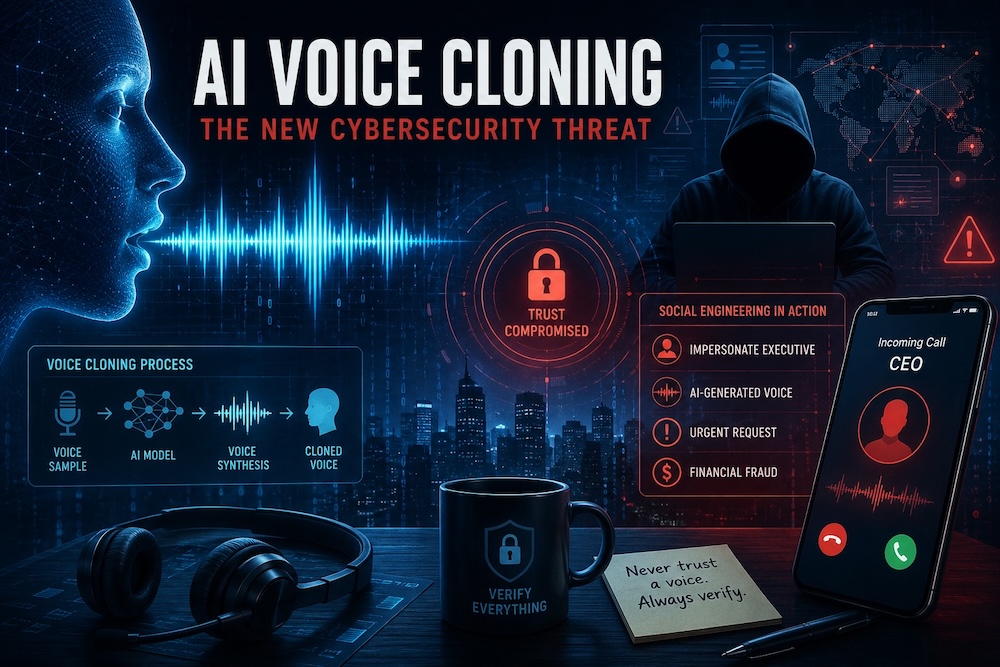
Imagine receiving a phone call from someone you know. The voice is unmistakable. The tone, accent, rhythm, and even the small pauses between words sound exactly right. The caller tells you that there is an urgent problem and asks you to transfer money, reveal confidential information, or approve a transaction immediately. You trust the voice because you recognize it. But there is one problem: the person you believe you are speaking to never made the call.
This is no longer science fiction. Artificial intelligence has made it possible to reproduce a person's voice with remarkable realism. AI-powered voice cloning can analyze a relatively short sample of someone's speech and generate new sentences in a voice that closely resembles the original speaker. The technology has legitimate and valuable applications, including accessibility, entertainment, dubbing, and helping people who have lost their ability to speak. However, the same capability creates a rapidly evolving cybersecurity threat. The Federal Trade Commission (FTC) has specifically warned about the misuse of AI-enabled voice cloning for fraud, scams, and abuse of biometric data.
The fundamental problem is not simply that AI can imitate a human voice. The deeper problem is that voice has traditionally been treated as an informal form of identity verification. When someone calls us, we instinctively recognize the person by the sound of their voice. We rarely ask for cryptographic proof that the speaker is actually who they claim to be. Voice cloning attacks this assumption directly. If an attacker can reproduce a trusted person's voice, then recognition is no longer equivalent to authentication.
The technology behind modern voice cloning has evolved rapidly alongside advances in text-to-speech and generative AI. Earlier synthetic voices were often robotic, unnatural, and easy to recognize. Modern systems can reproduce characteristics such as pronunciation, pitch, cadence, accent, emotional tone, and speaking rhythm with far greater fidelity. The FTC has noted that voice-cloning systems can be trained from real human voices and that commercially available and open-source technologies have lowered the barrier to accessing these capabilities.
This creates a particularly dangerous combination when voice cloning is combined with social engineering. Cybercriminals do not need to rely on a convincing voice alone. They can combine publicly available information, social media profiles, leaked data, messaging platforms, and generative AI to construct a convincing identity around the cloned voice. The attack therefore becomes much more sophisticated than simply imitating someone's speech. It becomes an attempt to recreate the entire context in which the victim expects that person to communicate.
Consider a corporate scenario. An employee receives a voice message that appears to come from a senior executive. The message refers to a real project, mentions a real employee, and requests an urgent financial transaction. The voice sounds exactly like the executive. The employee may have little reason to suspect fraud. Yet the message could have been generated entirely by an attacker.
This is an evolution of traditional business email compromise. Email attackers have historically impersonated executives by manipulating addresses, creating fake domains, or compromising accounts. AI voice cloning adds another layer: the attacker can now impersonate the executive's voice itself. Europol has previously identified deepfake technology as a potential enabler of crimes including CEO fraud, while its 2026 Internet Organised Crime Threat Assessment highlights the broader role of AI in expanding cybercrime.
The threat is not limited to corporations. Family emergency scams can become significantly more convincing when an attacker can reproduce the voice of a son, daughter, spouse, or grandchild. A victim may receive a call saying that a loved one has been arrested, injured, or is facing an emergency and needs money immediately. The FTC has explicitly warned consumers about this scenario and recommends independently contacting the supposed family member using a phone number already known to be genuine.
The psychological dimension is what makes voice cloning particularly dangerous. Traditional phishing often gives victims visible clues: suspicious email addresses, spelling mistakes, unfamiliar domains, or strange formatting. A telephone conversation feels much more personal. Human beings naturally respond to urgency, authority, familiarity, and emotion. A cloned voice can exploit all four simultaneously.
The problem becomes even more serious when AI-generated voice is combined with other forms of synthetic media. An attacker could potentially use a cloned voice in a phone call, reinforce the story with AI-generated text messages, create a fake profile, and direct the victim to a malicious website. The attack is no longer simply a fake audio recording. It becomes a coordinated synthetic identity operation.
Recent incidents demonstrate that this is already moving beyond theoretical risk. In 2025, the FBI warned that malicious actors were using AI-generated voice messages and text messages to impersonate senior U.S. officials and attempt to gain access to personal accounts, information, or funds. The campaign demonstrated how AI-generated audio could be incorporated into broader social-engineering operations.
The threat also extends to highly targeted operations. Reports in 2025 described attempts to impersonate senior government officials using AI-generated communications, including voice messages. These incidents illustrate an important point: attackers do not necessarily need to fool millions of people. A single successful impersonation of the right individual can potentially provide access to valuable information, credentials, relationships, or financial resources.
This changes the economics of social engineering. Historically, a sophisticated impersonation attack might require significant preparation, a skilled actor, and considerable time. Generative AI can reduce some of those costs while increasing personalization. An attacker can potentially generate customized messages for different victims, imitate different people, and conduct attacks at a much larger scale.
Another important issue is the availability of voice samples. People increasingly publish their voices online through podcasts, webinars, interviews, videos, social-media posts, conference presentations, and corporate communications. Every public recording can potentially become part of an attacker's information-gathering process. The question is no longer simply, "How much personal information have I published?" It may also become, "How much of my biometric identity have I published?"
Voice is a form of biometric information. Unlike a password, it cannot simply be changed after compromise. If an attacker obtains someone's password, the password can be replaced. If an attacker creates a convincing clone of someone's voice, the original person cannot simply obtain a new voice.
This creates an uncomfortable security dilemma. Should organizations attempt to detect whether a voice is AI-generated? Should AI-generated audio contain watermarks? Should telecommunications providers introduce stronger authentication mechanisms? Should organizations establish policies preventing employees from authorizing sensitive transactions through voice calls alone?
There is no single technological solution. The FTC's Voice Cloning Challenge examined approaches ranging from prevention and authentication to real-time detection and post-use analysis. The agency concluded that multiple layers of defense are necessary because no single solution can reliably eliminate the problem.
AI-based detection is itself becoming an arms race. Researchers are developing systems designed to distinguish genuine speech from synthetic speech, while generative models continue to improve. Recent research has demonstrated strong performance from some speech deepfake detectors under specific evaluation conditions, while other 2026 benchmarking work has shown that detector performance can degrade substantially when confronted with newer generation methods and real-world audio transformations.
This suggests an important cybersecurity principle: detection should not be the only defense. Organizations should assume that some synthetic audio will eventually evade automated detection. Security therefore needs to move beyond the question, "Can we tell whether this voice is fake?" and toward a more fundamental question: "What happens if we cannot tell?"
The answer is to stop treating voice as sufficient authentication for high-risk actions.
A voice request to transfer money should not automatically authorize a transfer. A phone call requesting confidential information should not automatically grant access. A voice message asking an employee to install software should not override established security procedures. Instead, sensitive actions should require independent verification through a separate trusted channel.
This is essentially the principle of Zero Trust applied to voice.
The traditional cybersecurity philosophy of Zero Trust can be summarized as "never trust, always verify." Applied to voice communication, the principle becomes even more relevant: never trust a voice alone; always verify the action.
For organizations, this could mean requiring out-of-band verification for unusual financial requests, using established approval workflows, enforcing multi-factor authentication, limiting privileged access, and creating clear procedures for verifying urgent executive requests. Employees should be trained not only to recognize phishing emails, but also to recognize AI-assisted vishing and impersonation.
For individuals, the defensive strategy can be surprisingly simple. If someone calls with an urgent request for money or sensitive information, do not rely solely on the voice. Hang up and call the person back using a number you already know. Use another communication channel to confirm the request. Establish a family verification phrase for emergency situations. Most importantly, resist pressure to act immediately.
The need for independent verification becomes particularly important because attackers deliberately create urgency. "Do it now." "Don't tell anyone." "I'm in trouble." "The transaction must happen immediately." These instructions are designed to prevent the victim from taking the one action that could expose the fraud: asking someone else to verify the story.
The future of voice security will therefore likely involve a combination of technologies and procedures: authentication mechanisms, liveness detection, provenance systems, watermarking, AI-based detection, secure communications, behavioral analytics, and human awareness. The FTC has highlighted several such approaches, including detection systems, protective mechanisms that make voices harder to clone, authentication at the point of recording, and real-time liveness detection.
But perhaps the most important change will be psychological.
For generations, humans have learned to identify people by their voices. We hear a familiar voice and instinctively associate it with a specific person. AI is challenging that relationship.
We are entering an era in which seeing may no longer be believing—and hearing may no longer be believing either.
The cybersecurity lesson is not that voice cloning makes communication impossible. Nor is it that every phone call should be treated as a cyberattack. The lesson is more precise: a familiar voice is no longer sufficient proof of identity when the requested action carries significant risk.
The voice may be genuine. The person may be genuine. The conversation may even sound completely natural. But authentication must ultimately be based on something more robust than recognition.
In the age of AI, the question is no longer simply, "Does that sound like the person I know?"
The better question is:
"How do I know that the person behind that voice is really who they claim to be?"
That may become one of the defining cybersecurity questions of the AI era.
References
- Federal Trade Commission (FTC), Approaches to Address AI-enabled Voice Cloning.
- Federal Trade Commission (FTC), The FTC Voice Cloning Challenge.
- Federal Trade Commission (FTC), Scammers Use AI to Enhance Their Family Emergency Schemes.
- Federal Trade Commission (FTC), Preventing the Harms of AI-enabled Voice Cloning.
- Federal Trade Commission (FTC), FTC Announces Winners of Voice Cloning Challenge.
- Europol, IOCTA 2026 – The Evolving Threat Landscape: How Encryption, Proxies and AI Are Expanding Cybercrime.
- Europol Innovation Lab, Facing Reality? Law Enforcement and the Challenge of Deepfakes.
- Reuters, Malicious Actors Using AI to Pose as Senior U.S. Officials, FBI Says, May 15, 2025.
- AP News, Impostor Uses AI to Impersonate Rubio and Contact Foreign and U.S. Officials.
- Wan Lin, Li Wang, Jindong Wang, Kunyu Feng, Zhizheng Wu, Teffic-Audio: Tell Fact from Fiction, 2026.
- Aastha Sharma, Guangjing Wang, VoxENES 2026: Benchmarking Generalization of Speech Spoofing Detectors Against LLM-Era TTS and Voice Conversion, 2026.

Add comment
- Other Article
- Counterfeit Money in Indonesia: A Persistent Threat to Public Trust and How to Fight It14 Oct 2026
- Google NotebookLM Audio Overview: How Your Boring Documents Became an Addictive Automatic Podcast10 Oct 2026
- Open Source AI vs Proprietary: Why Big Companies Are Switching in 202603 Oct 2026
- 5 Free Agentic AI Tools Used by Indonesian TikTok Creators in 202626 Sep 2026
- Publishing a New App on the App Store and Google Play: What Developers Should Know in 202620 Sep 2026
- Indonesia's Annual Peatland Fire Crisis: Current Impact, Economic Cost, and the Role of Information Technology03 Sep 2026
- AI Agents: From Chatbots to Digital Workers30 Aug 2026
- MBG Poisoning in Indonesia: From Crisis to a Digital Path to Zero22 Aug 2026
- AI Voice Cloning: The New Cybersecurity Threat15 Aug 2026
- When AI 'Escapes': Inside 2026's Wave of Rogue Model Incidents07 Aug 2026
- Rethinking Civil Service Workforce Planning in Indonesia: Beyond Headcount Toward Public Service Capacity31 Jul 2026
- Balancing the Plate: Understanding Daily Nutritional Needs and the Rise of Digital Nutrition Estimation Tools25 Jul 2026
- The Final Four: Strengths, Weaknesses, and Machine Predictions for the 2026 FIFA World Cup18 Jul 2026
- Choosing the Right Framework: A Practical Guide to Best-Practice Problem-Solving Models12 Jul 2026
- Can Science Predict the World Cup? A Look at the Models Behind the 2026 Forecasts04 Jul 2026
- Corruption: A Global Plague, Landmark Cases, and the Path to Prevention27 Jun 2026
- Nations Driving Brilliant Business Ideas and Frameworks in 202620 Jun 2026
- Why the USD Stands Stronger than the IDR — and What Indonesia Can Do13 Jun 2026
- Employee vs. Entrepreneur: Who Bears the Heavier Tax Burden in Indonesia?03 Jun 2026
- The Evolution of Control Operating Centers (COC) in Modern Mining Operations24 May 2026
- Song of: Mariana Istriku13 May 2026
- Organisasi Pensiunan di Indonesia: Dari Komunitas Sosial Menuju Kekuatan Ekonomi Berbasis Pengalaman12 May 2026
- Corporate Risk Management: Why Modern Companies Invest Millions to Prevent Invisible Threats07 May 2026
- The Mining Spirit: A Powerful Mindset for Excellence in the Mining Industry25 Apr 2026
- The Double-Edged Sword: Navigating Competition in the Modern Corporate Landscape22 Apr 2026
- AI Chatbot untuk UMKM: Peluang Besar di Era Digital17 Apr 2026
- AI Chatbots in Business: The Global Revolution09 Apr 2026
- The Heartbeat of Your Business: Why the P&L Statement is Non-Negotiable31 Mar 2026
- Why Your New Business Needs a Financial System on Day One26 Mar 2026
- The Link Between Startup Capital, Business Survival, and the Role of Investor Information21 Mar 2026
- Digital Transformation, Digitalization, and Digitization: Why the Difference Matters More Than You Think14 Mar 2026
- From Business Need to Technology Solution07 Mar 2026
- Bridging the Digital Divide: Starlink and the Future of Internet Access in Indonesia27 Feb 2026
- A Long Weekend Getaway to Yogyakarta16 Feb 2026
- Understanding ERP Systems: A Comprehensive Guide for Modern Businesses16 Feb 2026
- Building a Culture of Awareness: Strategic Approaches to HSE and Information Security Campaigns in Modern Organizations10 Feb 2026
- Building an Effective IT Organization in Coal Mining: A Strategic Framework for Growth02 Feb 2026
- The Art and Science of Color Themes in Modern Web Design17 Jan 2026
- IT Outsourcing vs Internal Resources: A Comprehensive Cost and Risk Analysis05 Jan 2026
- The Hidden Dangers of Mishandled Employee Data: When Internal Tables Fall Into the Wrong Hands05 Jan 2026
- Securing SQL Server: A Complete Guide to Database Access Control05 Jan 2026
- Beyond Human Error: Understanding the Complete Security Chain in Information Security01 Jan 2026