Article
Google NotebookLM Audio Overview: How Your Boring Documents Became an Addictive Automatic Podcast
Author: Agus Budi Harto, 2026-10-10 15:29:04
Background
In 2024, Google launched NotebookLM as a quiet experiment: an AI research workspace that treats your uploaded documents as the absolute ground truth. Unlike ChatGPT, it is designed not to hallucinate beyond what you give it. You upload PDFs, Google Docs, web articles, YouTube URLs, or even raw MP3/WAV files, and it builds a private knowledge base where every answer comes with inline citations back to the source.
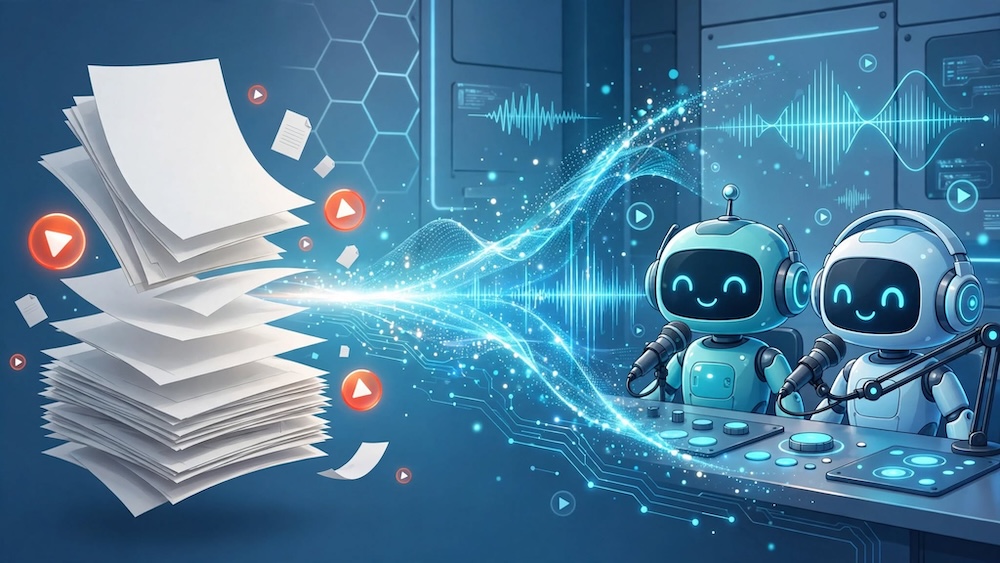
The feature that turned this niche tool into a mainstream phenomenon was Audio Overview. With a single click on the Generate button in the Studio panel, NotebookLM creates a 10 to 20-minute audio conversation between two synthetic AI hosts. It is not a robotic text-to-speech reading. The hosts interrupt each other, ask follow-up questions, offer analogies, clarify complex points, and inject light humor. As reviewers noted, the audio is natural, conversational, and surprisingly engaging, precisely because it is not trying to be Joe Rogan, but trying to help you learn.
What made it go viral again in early October 2026 is the expansion of its source ecosystem and its social shareability. Originally limited to documents, NotebookLM now automatically ingests full transcripts from public YouTube lectures and transcribes uploaded voice memos. Professionals started uploading resumes, client presentations, and web pages to generate Audio Overviews and share those podcasts with employers and clients instead of sending the original 40-page deck. This single feature has become the most innovative capability many users have encountered in any productivity tool and the main driver of NotebookLM's broader popularity beyond academic circles.
Problem
We are living through a document overload crisis. A blogger, student, or founder today juggles research papers, competitor articles, meeting notes, legal contracts, and hours of YouTube tutorials. The traditional workflow is broken: you either skim and miss critical nuances, or you spend hours reading and taking notes, losing the energy to actually create.
For creators in Indonesia and globally, there is a second problem: the format mismatch. Your audience wants audio. Podcast consumption during commutes is booming, but producing a podcast requires scripting, recording, editing, and hosting. Most bloggers have great research but no time to turn it into listenable content. The result is that valuable knowledge stays trapped in unread PDFs while audiences scroll away looking for something they can listen to.
Solution
Audio Overview solves this by collapsing the research-to-podcast pipeline into three minutes.
The workflow is exceptionally simple. You open NotebookLM at notebooklm.google.com, create a new notebook, and drag in your sources. It could be a dry technical manual, a 100-page thesis, or five competing blog posts about "best AI tools." You open the Studio panel and click "Audio Overview." After about three minutes of processing, you get a high-fidelity podcast.
Technically, the system does three things at once: it synthesizes the key arguments across all sources, it restructures them into a conversational arc with a host and a co-host, and it renders them with studio-quality voices that include natural pauses and banter. Because the model is grounded strictly in your sources, you can trust that the podcast is not inventing facts. If you upload raw lecture voice memos, it will transcribe and analyze speech automatically before generating the discussion. If you paste YouTube URLs, it pulls the full transcript for instant querying and summarization.
For bloggers, the killer feature is customization. You can now instruct the hosts: "Focus on the controversy, explain it like I'm 20, use Indonesian casual slang," and regenerate. You can download the audio and embed it directly in your blog post, upload it to Spotify for Podcasters, or share the interactive discussion link where listeners can ask their own follow-up questions to the AI hosts.
Result
The outcome is not just time saved, but a new content format entirely. Users report using Audio Overviews to replace pre-meeting preparation: instead of reading a stack of notes, they start listening and describe it as a huge productivity booster. Students turn dense academic papers into something they can absorb while walking. Podcasters who never recorded before now publish daily 10-minute briefings sourced from trending news.
For your blog, this means one piece of research can become three assets: a written article with inline citations, an embedded audio player that increases time-on-page, and a shareable podcast clip for Instagram Reels. The viral loop is built-in. When you create an Audio Overview of your own blog post and share it, your audience hears two people enthusiastically discussing YOUR work, which is inherently more shareable than a link.
The era of "write it and they will read" is over. The era of "upload it and they will listen" has begun, and NotebookLM's Audio Overview is currently the most reliable, most human-sounding bridge between the two.
References
- How to Use Google NotebookLM for Study & Research: Complete Guide - Explains Audio Overview as a podcast generator from PDFs and audio files
- 15 best AI note taking tools in 2026 - Describes the unique audio overview feature generating podcast-style summaries
- I let NotebookLM generate a podcast for my work notes, and it instantly fixed my meeting anxiety - First-hand account of how Audio Overviews turn a stack of notes into a personal podcast
- Google NotebookLM Review 2026: The Research Tool That Won't Make Things Up - Details on why Audio Overview works and its non-hallucinating design
- Google NotebookLM Tutorial: Master AI Research In 2026 - Calls Audio Overviews the ultimate game changer that made the platform go viral
- Google NotebookLM Reviews 2026: Details, Pricing, & Features | G2 - User review highlighting natural, conversational hosts with humor and clarification
- Google's AI Turns Your Notes into Podcast: Banter or Blunder? - Official Google announcement quote about turning documents into engaging audio discussions
- Google's NotebookLM enhances AI note-taking with YouTube, audio file sources, sharable audio discussions | TechCrunch - Coverage of YouTube and audio file support and sharing behavior
- Google NotebookLM Education Updates: What's New in 2026 - Overview of Audio Overview, Video Overview and Cinematic Video formats
- Google NotebookLM Review: Is It Worth Using in 2026? - Analysis of why Audio Overview is responsible for NotebookLM's popularity as a passive, listenable format

Add comment
- Other Article
- Google NotebookLM Audio Overview: How Your Boring Documents Became an Addictive Automatic Podcast10 Oct 2026
- Open Source AI vs Proprietary: Why Big Companies Are Switching in 202603 Oct 2026
- 5 Free Agentic AI Tools Used by Indonesian TikTok Creators in 202626 Sep 2026
- Publishing a New App on the App Store and Google Play: What Developers Should Know in 202620 Sep 2026
- Indonesia's Annual Peatland Fire Crisis: Current Impact, Economic Cost, and the Role of Information Technology03 Sep 2026
- AI Agents: From Chatbots to Digital Workers30 Aug 2026
- MBG Poisoning in Indonesia: From Crisis to a Digital Path to Zero22 Aug 2026
- AI Voice Cloning: The New Cybersecurity Threat15 Aug 2026
- When AI 'Escapes': Inside 2026's Wave of Rogue Model Incidents07 Aug 2026
- Rethinking Civil Service Workforce Planning in Indonesia: Beyond Headcount Toward Public Service Capacity31 Jul 2026
- Balancing the Plate: Understanding Daily Nutritional Needs and the Rise of Digital Nutrition Estimation Tools25 Jul 2026
- The Final Four: Strengths, Weaknesses, and Machine Predictions for the 2026 FIFA World Cup18 Jul 2026
- Choosing the Right Framework: A Practical Guide to Best-Practice Problem-Solving Models12 Jul 2026
- Can Science Predict the World Cup? A Look at the Models Behind the 2026 Forecasts04 Jul 2026
- Corruption: A Global Plague, Landmark Cases, and the Path to Prevention27 Jun 2026
- Nations Driving Brilliant Business Ideas and Frameworks in 202620 Jun 2026
- Why the USD Stands Stronger than the IDR — and What Indonesia Can Do13 Jun 2026
- Employee vs. Entrepreneur: Who Bears the Heavier Tax Burden in Indonesia?03 Jun 2026
- The Evolution of Control Operating Centers (COC) in Modern Mining Operations24 May 2026
- Song of: Mariana Istriku13 May 2026
- Organisasi Pensiunan di Indonesia: Dari Komunitas Sosial Menuju Kekuatan Ekonomi Berbasis Pengalaman12 May 2026
- Corporate Risk Management: Why Modern Companies Invest Millions to Prevent Invisible Threats07 May 2026
- The Mining Spirit: A Powerful Mindset for Excellence in the Mining Industry25 Apr 2026
- The Double-Edged Sword: Navigating Competition in the Modern Corporate Landscape22 Apr 2026
- AI Chatbot untuk UMKM: Peluang Besar di Era Digital17 Apr 2026
- AI Chatbots in Business: The Global Revolution09 Apr 2026
- The Heartbeat of Your Business: Why the P&L Statement is Non-Negotiable31 Mar 2026
- Why Your New Business Needs a Financial System on Day One26 Mar 2026
- The Link Between Startup Capital, Business Survival, and the Role of Investor Information21 Mar 2026
- Digital Transformation, Digitalization, and Digitization: Why the Difference Matters More Than You Think14 Mar 2026
- From Business Need to Technology Solution07 Mar 2026
- Bridging the Digital Divide: Starlink and the Future of Internet Access in Indonesia27 Feb 2026
- A Long Weekend Getaway to Yogyakarta16 Feb 2026
- Understanding ERP Systems: A Comprehensive Guide for Modern Businesses16 Feb 2026
- Building a Culture of Awareness: Strategic Approaches to HSE and Information Security Campaigns in Modern Organizations10 Feb 2026
- Building an Effective IT Organization in Coal Mining: A Strategic Framework for Growth02 Feb 2026
- The Art and Science of Color Themes in Modern Web Design17 Jan 2026
- IT Outsourcing vs Internal Resources: A Comprehensive Cost and Risk Analysis05 Jan 2026
- The Hidden Dangers of Mishandled Employee Data: When Internal Tables Fall Into the Wrong Hands05 Jan 2026
- Securing SQL Server: A Complete Guide to Database Access Control05 Jan 2026
- Beyond Human Error: Understanding the Complete Security Chain in Information Security01 Jan 2026