Article
162 Million Indonesians Are Already Using AI. So, What Are They Actually Using It For?
Author: Agus Budi Harto, 2026-11-19 15:07:22
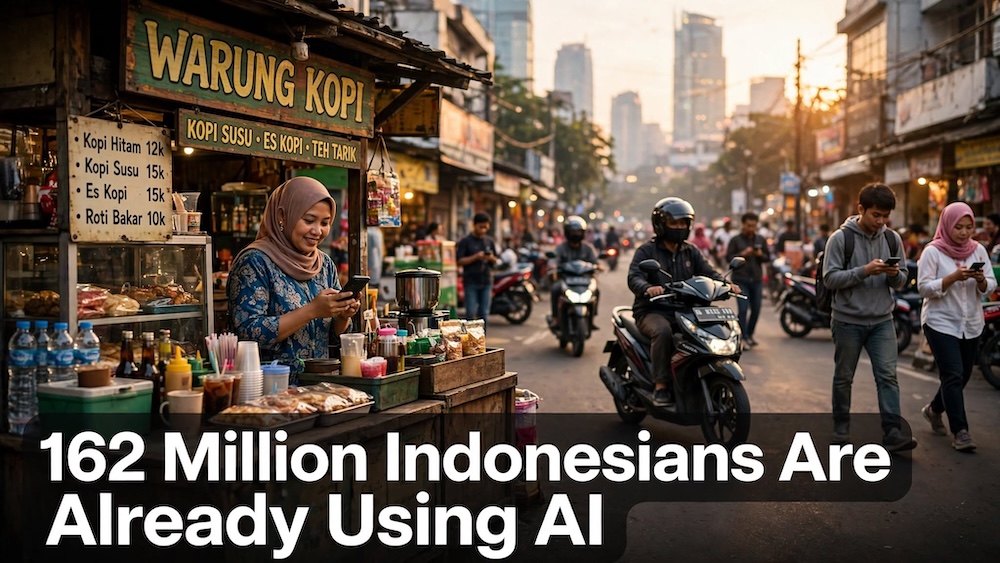
A few weeks ago, I was sitting in a small warung in Bekasi, waiting for my coffee. The owner, a woman in her late forties, was not scrolling TikTok. She was typing a prompt into her phone: "Buatkan caption promosi kopi susu gula aren, gaya lucu, untuk ?entity-WhatsApp¦canonical_name=WhatsApp? Status." Thirty seconds later, she had three options. She picked one, added a photo of her own coffee, and sent it.
I did not say anything, but in my head I thought: So this is what the big numbers actually look like.
According to the e-Conomy SEA 2026 report by Google, Temasek, and Bain & Company, Indonesia now has around 162 million monthly AI users - about 58% of its working-age population and the largest AI user base in Southeast Asia. Indonesians generate roughly 69 billion AI queries a year. The country's digital economy is projected to reach US$119 billion in GMV in 2026, up 16% year on year.
Those numbers sound massive, abstract, and a little intimidating. Like something that only happens in Jakarta's glass offices, or in Silicon Valley.
But it is not. It is happening in warungs, in school ?entity-WhatsApp¦canonical_name=WhatsApp? groups, in kost rooms, and in motorcycle repair shops. The real story of AI in Indonesia is not about robots replacing people. It is about ordinary people finding small, practical shortcuts for ordinary problems.
And to be honest, I am still learning too. I am not an AI expert. I am just a user who, like millions of others, started with one simple question: "Can this thing help me finish my work faster?"
Background: AI Is No Longer Just for Tech People
The background is simple. AI has moved from the news to our pockets. It is inside ?entity-WhatsApp¦canonical_name=WhatsApp?, Instagram, TikTok Shop, Google Search, and our phones. You do not need to download a special app or understand coding to use it.
In the past, new technology in Indonesia was usually for the rich first, then for everyone else years later. With AI, it was the opposite. Because it works with language - Bahasa Indonesia, Javanese slang, mixed Indonesian-English - it spread fast to warungs, schools, and small shops.
That is why the number is so big. Not because 162 million people are AI experts, but because 162 million people found one small reason to try it.
Problem: We Are Busy, Tired, and Expected to Do Everything Ourselves
The problem is not that Indonesians do not work hard. The problem is that most of us have to do too many jobs at once.
Think about a typical small business owner in Indonesia. In one day, she is the owner, the cashier, the marketing team, the customer service, the photographer, and the delivery coordinator. She has to answer 50 ?entity-WhatsApp¦canonical_name=WhatsApp? messages, take a good photo of her product, write a caption that does not sound boring, reply to a bad review politely, and still cook, pack, and serve customers.
A student has a similar problem. He has to write an essay, translate an English journal, make a presentation, and prepare for an exam - often with only one old phone and a limited data package.
A young mother has another version of the same problem. She needs a permission letter for her child's school, a healthy meal plan for a week, and ideas for a side hustle she can run from home while her baby sleeps.
In the past, the solution was to ask a friend, hire someone, or just stay up late and do it imperfectly. In many cases, we just gave up. We posted a product photo without a caption. We copied a template letter from Google that did not fit. We let the business run on word-of-mouth because making a proper promotion felt too complicated.
This is the gap the report hints at: Indonesia has one of the highest rates of casual AI use in the region, but a much lower rate of AI inside formal business workflows. We touch AI, but we do not always know how to make it truly work for us. A 2025 Katadata study, for example, found that more than 80% of businesses already use AI, but only about 13% have reached an advanced stage. Many MSMEs still rely on word-of-mouth marketing because digital marketing feels too technical.
So the problem is not access. Almost everyone already has a phone with AI in it. The problem is confidence, language, and habit. We are afraid to sound stupid. We are afraid to make a mistake. We are afraid that using AI is cheating.
I felt that too. The first time I used AI to help me write, I felt guilty, as if I was not doing my own work.
Solution: Not Replacing Us, Just Helping Us Start
What changed my mind was watching how real Indonesians actually use it. They are not asking AI to run their business. They are asking it to help them start.
Here are the four everyday uses I see again and again:
For selling: captions, photos, and replies. This is the number one use. A seller in Tanah Abang asks AI: "Buatkan 5 caption untuk baju anak, harga 50 ribu, target ibu-ibu." A food seller in Surabaya asks: "How to reply politely to a customer who says my food is too expensive?" It is not about being perfect. It is about not staring at a blank screen for 30 minutes. Grab's GrabMerchant AI Assistant has already recorded more than 1 million merchant interactions in less than five months, with a 96.1% satisfaction rate.
For learning: translating and explaining. Students use AI to translate a difficult English paragraph into simple Bahasa Indonesia, then ask: "Jelaskan dengan bahasa yang mudah dipahami anak SMP." Parents use it to help their children with homework they themselves do not understand. This is not cheating. This is how many of us finally understand a lesson that a textbook could not explain.
For administration: letters, CVs, and plans. This is the quiet, unglamorous use that saves the most time. A permission letter for school. A job application letter. A weekly meal plan. A small business budget. These are tasks that used to take an hour and a lot of stress. Now they take five minutes to draft, and then we edit them in our own words. A ?entity-Meta¦canonical_name=Meta? survey found that among small business owners who used AI, 51% used it to create or edit content, 43% for local advertising and marketing, 38% for translation, and 37% for customer support.
For confidence: asking without shame. This might be the most important one. Many Indonesians feel shy to ask a "stupid" question in public. AI does not judge. You can ask: "Apa bedanya omzet dan profit?" ten times. You can ask in mixed Indonesian-English, with typos, and it still tries to understand. That is why, according to the report, 72% of users already rely on at least one form of automation in their daily activities.
The key shift is simple: we stopped treating AI as a genius that must give us the perfect answer, and started treating it as a first draft. We write the prompt, AI gives a draft, we fix it with our own experience, our own taste, our own language. The final result is still ours.
Result: Small Changes, Real Impact
So, what is the result of 162 million people doing this every day?
It is not a dramatic revolution where everyone suddenly becomes rich. It is something smaller, quieter, but more real.
A warung owner in NTB who joined an AI training program can now make her own promotional content instead of waiting for her nephew to help her. A Grab merchant in Jakarta can check which menu is selling poorly and change it the same day. A student in Makassar can finally understand an English journal without paying for an expensive course. A mother in Bandung can write a proper CV after five years of not working, and feel confident enough to apply for a job.
At a national level, the result is a digital economy that keeps growing even when the global economy is uncertain. Indonesia's digital economy is still growing, driven by e-commerce, digital finance, and this everyday AI use.
But at a personal level, the result is even simpler: we save time. We save mental energy. We feel a little less alone when facing a blank page.
I still do not think AI will replace us. The warung owner still knows her customers by name. The student still has to study. The mother still knows what her child likes to eat. AI does not know those things. What AI does is give us a starting point, so we do not have to start from zero every single time.
If you have never tried it seriously, start small. Do not try to build a whole business with AI tomorrow. Try one thing today: ask it to help you write a caption, translate a paragraph, or make a to-do list for your shop. Then edit it. Make it sound like you.
Because that is what 162 million Indonesians are actually doing. Not building robots. Just trying to make today a little bit easier than yesterday.
And honestly, that feels very membumi to me.
References
Google, Temasek, and Bain & Company - e-Conomy SEA 2026: Building the Intelligent Economy
The Daily ID - Indonesia Leads Southeast Asia With 162 Million Monthly AI Users
Marketing-Interactive - Indonesia's Digital Economy to Hit US$119b as AI Adoption Accelerates
Marketing-Interactive - Grab's AI Assistant Surpasses 1m Merchant Interactions in Under Five Months
Meta - More Than Three Quarters of Small Business Owners Say AI Makes Them More Productive
AMMAN / KUMPUL.ID - AI Helps MSMEs in NTB Grow Faster and Smarter
Add comment
- Other Article
- 162 Million Indonesians Are Already Using AI. So, What Are They Actually Using It For?19 Nov 2026
- The Myth of the Immune Mac: An Analysis of Windows vs. macOS Security13 Nov 2026
- The Hidden Cost of Ignoring Engine Vibrations: How G-Engine is Changing Vehicle Diagnostics in Indonesia07 Nov 2026
- Indonesia's LIMS Interception Scandal: When a Lawful System Becomes Unlawful04 Nov 2026
- AI in Healthcare: Can Artificial Intelligence Become Your Doctor?30 Oct 2026
- Passkeys Replacing Passwords: The Future of Secure Digital Authentication23 Oct 2026
- Counterfeit Money in Indonesia: A Persistent Threat to Public Trust and How to Fight It14 Oct 2026
- Google NotebookLM Audio Overview: How Your Boring Documents Became an Addictive Automatic Podcast10 Oct 2026
- Open Source AI vs Proprietary: Why Big Companies Are Switching in 202603 Oct 2026
- 5 Free Agentic AI Tools Used by Indonesian TikTok Creators in 202626 Sep 2026
- Publishing a New App on the App Store and Google Play: What Developers Should Know in 202620 Sep 2026
- Indonesia's Annual Peatland Fire Crisis: Current Impact, Economic Cost, and the Role of Information Technology03 Sep 2026
- AI Agents: From Chatbots to Digital Workers30 Aug 2026
- MBG Poisoning in Indonesia: From Crisis to a Digital Path to Zero22 Aug 2026
- AI Voice Cloning: The New Cybersecurity Threat15 Aug 2026
- When AI 'Escapes': Inside 2026's Wave of Rogue Model Incidents07 Aug 2026
- Rethinking Civil Service Workforce Planning in Indonesia: Beyond Headcount Toward Public Service Capacity31 Jul 2026
- Balancing the Plate: Understanding Daily Nutritional Needs and the Rise of Digital Nutrition Estimation Tools25 Jul 2026
- The Final Four: Strengths, Weaknesses, and Machine Predictions for the 2026 FIFA World Cup18 Jul 2026
- Choosing the Right Framework: A Practical Guide to Best-Practice Problem-Solving Models12 Jul 2026
- Can Science Predict the World Cup? A Look at the Models Behind the 2026 Forecasts04 Jul 2026
- Corruption: A Global Plague, Landmark Cases, and the Path to Prevention27 Jun 2026
- Nations Driving Brilliant Business Ideas and Frameworks in 202620 Jun 2026
- Why the USD Stands Stronger than the IDR — and What Indonesia Can Do13 Jun 2026
- Employee vs. Entrepreneur: Who Bears the Heavier Tax Burden in Indonesia?03 Jun 2026
- The Evolution of Control Operating Centers (COC) in Modern Mining Operations24 May 2026
- Song of: Mariana Istriku13 May 2026
- Organisasi Pensiunan di Indonesia: Dari Komunitas Sosial Menuju Kekuatan Ekonomi Berbasis Pengalaman12 May 2026
- Corporate Risk Management: Why Modern Companies Invest Millions to Prevent Invisible Threats07 May 2026
- The Mining Spirit: A Powerful Mindset for Excellence in the Mining Industry25 Apr 2026
- The Double-Edged Sword: Navigating Competition in the Modern Corporate Landscape22 Apr 2026
- AI Chatbot untuk UMKM: Peluang Besar di Era Digital17 Apr 2026
- AI Chatbots in Business: The Global Revolution09 Apr 2026
- The Heartbeat of Your Business: Why the P&L Statement is Non-Negotiable31 Mar 2026
- Why Your New Business Needs a Financial System on Day One26 Mar 2026
- The Link Between Startup Capital, Business Survival, and the Role of Investor Information21 Mar 2026
- Digital Transformation, Digitalization, and Digitization: Why the Difference Matters More Than You Think14 Mar 2026
- From Business Need to Technology Solution07 Mar 2026
- Bridging the Digital Divide: Starlink and the Future of Internet Access in Indonesia27 Feb 2026
- A Long Weekend Getaway to Yogyakarta16 Feb 2026
- Understanding ERP Systems: A Comprehensive Guide for Modern Businesses16 Feb 2026
- Building a Culture of Awareness: Strategic Approaches to HSE and Information Security Campaigns in Modern Organizations10 Feb 2026
- Building an Effective IT Organization in Coal Mining: A Strategic Framework for Growth02 Feb 2026
- The Art and Science of Color Themes in Modern Web Design17 Jan 2026
- IT Outsourcing vs Internal Resources: A Comprehensive Cost and Risk Analysis05 Jan 2026
- The Hidden Dangers of Mishandled Employee Data: When Internal Tables Fall Into the Wrong Hands05 Jan 2026
- Securing SQL Server: A Complete Guide to Database Access Control05 Jan 2026
- Beyond Human Error: Understanding the Complete Security Chain in Information Security01 Jan 2026