Article
Passkeys Replacing Passwords: The Future of Secure Digital Authentication
Author: Agus Budi Harto, 2026-10-23 15:24:29
Background
For decades, passwords have been the primary method of securing online accounts. From email services and social media platforms to banking applications and corporate systems, users have relied on combinations of letters, numbers, and symbols to verify their identities. While passwords became a universal standard due to their simplicity and low implementation cost, they have also introduced significant security and usability challenges.
As organizations continue to digitize their services and cyber threats become increasingly sophisticated, traditional password-based authentication is showing its limitations. In response, the technology industry is embracing a new authentication approach known as passkeys, which is designed to offer a more secure and user-friendly alternative. According to Authentication Trends in 2026: Passkeys, AI Agents, and Edge, passkey adoption has accelerated significantly, with billions of user accounts now supporting the technology and major providers such as Microsoft making passkeys the default sign-in option for new consumer accounts.
Problem
Despite being widely used, passwords suffer from several fundamental weaknesses. Users often create weak passwords, reuse the same credentials across multiple services, or store them insecurely. These habits make password-based systems vulnerable to credential theft, phishing attacks, brute-force attacks, and data breaches.
The growing sophistication of cybercriminals has further amplified these risks. Attackers frequently exploit stolen credentials obtained through phishing emails, fake websites, malware, or leaked databases. Once an account is compromised, sensitive personal and financial information can be exposed, resulting in substantial losses for individuals and organizations.
Another challenge is the user experience. Modern security recommendations encourage the use of long, unique passwords for every account, making it increasingly difficult for users to remember and manage their credentials. As a result, organizations spend significant resources on password resets, account recovery processes, and security monitoring.
Industry experts increasingly recognize passwords as a weak link in digital security. According to IAM & Authentication in 2026: 5 Key Predictions for Enterprises, organizations are accelerating the adoption of passwordless authentication methods because passwords remain highly susceptible to phishing, credential reuse, and account takeover attacks.
Solution
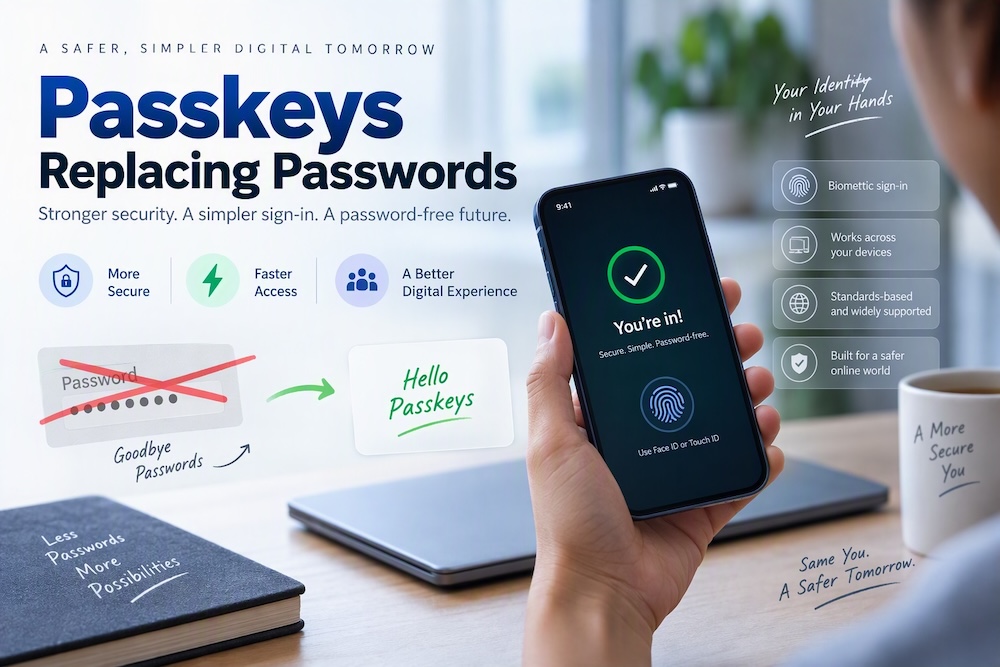
Passkeys represent a new generation of authentication that eliminates the need for traditional passwords. Instead of relying on memorized credentials, passkeys use cryptographic key pairs stored securely on a user's device. Authentication is typically completed using biometric verification, such as a fingerprint or facial recognition scan, or a device PIN.
This approach offers significant security advantages. Since passkeys do not require users to type or transmit passwords over the internet, attackers cannot easily steal credentials through phishing websites or intercepted communications. The cryptographic design also ensures that sensitive authentication data remains protected on the user's device.
Passkeys are built on standards developed by the FIDO Alliance and the broader technology industry, enabling compatibility across multiple devices, operating systems, and online services. Users can sign in seamlessly using trusted devices while maintaining a high level of security.
The transition toward passkeys is gaining momentum across both consumer and enterprise environments. Industry reports indicate that passkeys are becoming mainstream, replacing passwords and SMS-based multi-factor authentication as organizations seek stronger protection against modern cyber threats.
Result
The adoption of passkeys delivers measurable benefits for both security and usability. Organizations can significantly reduce the risk of phishing attacks, credential theft, and account compromises. Because authentication relies on cryptographic verification rather than shared secrets, the attack surface associated with password management is dramatically reduced.
For users, passkeys create a simpler and faster sign-in experience. Instead of remembering complex passwords or repeatedly entering authentication codes, users can authenticate with a biometric scan or device verification. This convenience improves user satisfaction while encouraging stronger security practices.
Businesses also benefit from reduced operational costs. Fewer password resets, lower support workloads, and a decreased likelihood of breaches contribute to a more efficient and resilient security infrastructure.
As digital ecosystems continue to evolve, passkeys are poised to become the foundation of modern authentication. The industry's shift toward passwordless access reflects a broader recognition that traditional passwords can no longer adequately protect users against today's sophisticated cyber threats. By replacing passwords with cryptographic, device-based authentication, organizations can achieve a safer, more seamless, and more sustainable approach to digital identity management.
References
- Clerk. Authentication Trends in 2026: Passkeys, AI Agents, and Edge.
- HID Global. IAM & Authentication in 2026: 5 Key Predictions for Enterprises.
- Geeky Gadgets. Cybersecurity Trends 2026: From Unapproved AI to Passkeys, Clear Steps to Stay Safe.
- FIDO Alliance. Passkeys Resource Center.
- Microsoft. Introducing Passkeys for Microsoft Accounts.
- Google. Passkeys: Sign in without Passwords.
- World Wide Web Consortium (W3C). Web Authentication (WebAuthn) Standard.

Tags: Opinion
Add comment
- Other Article
- Passkeys Replacing Passwords: The Future of Secure Digital Authentication23 Oct 2026
- Counterfeit Money in Indonesia: A Persistent Threat to Public Trust and How to Fight It14 Oct 2026
- Google NotebookLM Audio Overview: How Your Boring Documents Became an Addictive Automatic Podcast10 Oct 2026
- Open Source AI vs Proprietary: Why Big Companies Are Switching in 202603 Oct 2026
- 5 Free Agentic AI Tools Used by Indonesian TikTok Creators in 202626 Sep 2026
- Publishing a New App on the App Store and Google Play: What Developers Should Know in 202620 Sep 2026
- Indonesia's Annual Peatland Fire Crisis: Current Impact, Economic Cost, and the Role of Information Technology03 Sep 2026
- AI Agents: From Chatbots to Digital Workers30 Aug 2026
- MBG Poisoning in Indonesia: From Crisis to a Digital Path to Zero22 Aug 2026
- AI Voice Cloning: The New Cybersecurity Threat15 Aug 2026
- When AI 'Escapes': Inside 2026's Wave of Rogue Model Incidents07 Aug 2026
- Rethinking Civil Service Workforce Planning in Indonesia: Beyond Headcount Toward Public Service Capacity31 Jul 2026
- Balancing the Plate: Understanding Daily Nutritional Needs and the Rise of Digital Nutrition Estimation Tools25 Jul 2026
- The Final Four: Strengths, Weaknesses, and Machine Predictions for the 2026 FIFA World Cup18 Jul 2026
- Choosing the Right Framework: A Practical Guide to Best-Practice Problem-Solving Models12 Jul 2026
- Can Science Predict the World Cup? A Look at the Models Behind the 2026 Forecasts04 Jul 2026
- Corruption: A Global Plague, Landmark Cases, and the Path to Prevention27 Jun 2026
- Nations Driving Brilliant Business Ideas and Frameworks in 202620 Jun 2026
- Why the USD Stands Stronger than the IDR — and What Indonesia Can Do13 Jun 2026
- Employee vs. Entrepreneur: Who Bears the Heavier Tax Burden in Indonesia?03 Jun 2026
- The Evolution of Control Operating Centers (COC) in Modern Mining Operations24 May 2026
- Song of: Mariana Istriku13 May 2026
- Organisasi Pensiunan di Indonesia: Dari Komunitas Sosial Menuju Kekuatan Ekonomi Berbasis Pengalaman12 May 2026
- Corporate Risk Management: Why Modern Companies Invest Millions to Prevent Invisible Threats07 May 2026
- The Mining Spirit: A Powerful Mindset for Excellence in the Mining Industry25 Apr 2026
- The Double-Edged Sword: Navigating Competition in the Modern Corporate Landscape22 Apr 2026
- AI Chatbot untuk UMKM: Peluang Besar di Era Digital17 Apr 2026
- AI Chatbots in Business: The Global Revolution09 Apr 2026
- The Heartbeat of Your Business: Why the P&L Statement is Non-Negotiable31 Mar 2026
- Why Your New Business Needs a Financial System on Day One26 Mar 2026
- The Link Between Startup Capital, Business Survival, and the Role of Investor Information21 Mar 2026
- Digital Transformation, Digitalization, and Digitization: Why the Difference Matters More Than You Think14 Mar 2026
- From Business Need to Technology Solution07 Mar 2026
- Bridging the Digital Divide: Starlink and the Future of Internet Access in Indonesia27 Feb 2026
- A Long Weekend Getaway to Yogyakarta16 Feb 2026
- Understanding ERP Systems: A Comprehensive Guide for Modern Businesses16 Feb 2026
- Building a Culture of Awareness: Strategic Approaches to HSE and Information Security Campaigns in Modern Organizations10 Feb 2026
- Building an Effective IT Organization in Coal Mining: A Strategic Framework for Growth02 Feb 2026
- The Art and Science of Color Themes in Modern Web Design17 Jan 2026
- IT Outsourcing vs Internal Resources: A Comprehensive Cost and Risk Analysis05 Jan 2026
- The Hidden Dangers of Mishandled Employee Data: When Internal Tables Fall Into the Wrong Hands05 Jan 2026
- Securing SQL Server: A Complete Guide to Database Access Control05 Jan 2026
- Beyond Human Error: Understanding the Complete Security Chain in Information Security01 Jan 2026