Article
Indonesia's Annual Peatland Fire Crisis: Current Impact, Economic Cost, and the Role of Information Technology
Author: Agus Budi Harto, 2026-09-03 15:44:35
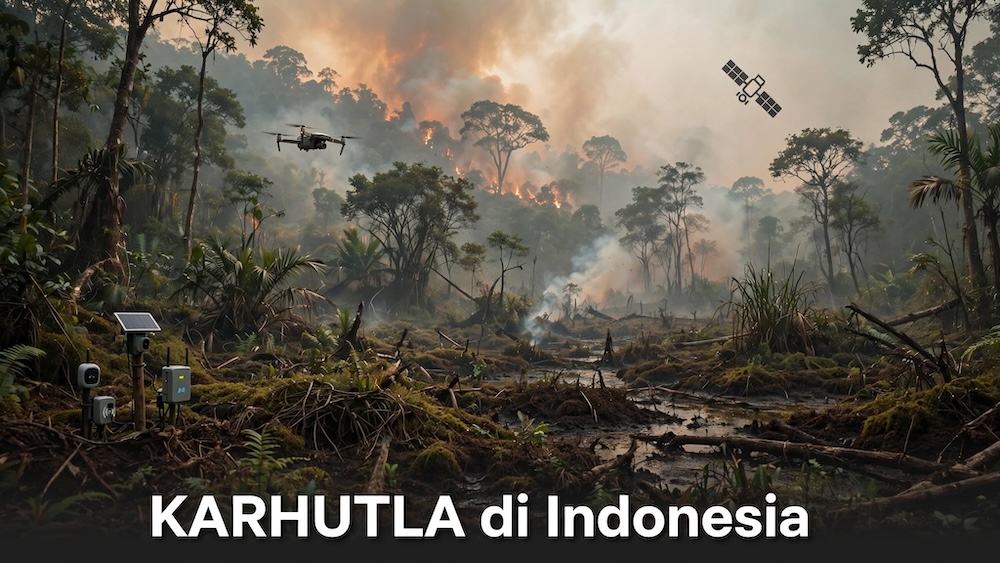
Indonesia is once again entering the peak of its annual forest and land fire (karhutla) season in September 2026. According to the Ministry of Forestry's SiPongi system, which monitors hotspots using NASA Terra/Aqua, SNPP, and NOAA-20 satellites, 1,370 high-confidence hotspots were detected nationally on September 1, 2026, an increase from the previous day, with concentrations remaining in West Kalimantan and Central Kalimantan. The Meteorology, Climatology, and Geophysics Agency (BMKG) had earlier predicted that the risk of karhutla would peak in August to September 2026 in line with the peak of the dry season.
In response, the government has declared a full alert status. The strategy focuses on Weather Modification Operations (TMC/OMC), water bombing using helicopters, and maximum deployment of ground forces. More than 1,000 additional personnel have been deployed under the Bawah Kendali Operasi (BKO) mechanism to strengthen field operations. As a precautionary measure to reduce human-caused ignition, the Ministry of Forestry has also closed nine National Parks starting September 1, 2026, prioritizing visitor safety and the efficiency of firefighting resources.
The economic impact has been staggering. The Center for Economic and Law Studies (CELIOS) estimates that the total economic and health costs due to karhutla from January to August 2026 alone range from Rp39.29 trillion to Rp123.1 trillion. This figure is driven not only by burned land but also by disrupted community economic activities and skyrocketing health costs due to haze exposure. This estimate does not yet account for potential expansion of fires until the end of 2026.
Law enforcement data highlights the scale of accountability. The Ministry of Environment reports that state losses from karhutla reached Rp5.30 trillion from 32 cases in the 2023-2025 period, while more than 30 corporations have been fined a total of Rp15 trillion — around Rp5 trillion for state losses and almost Rp10 trillion for environmental restoration. The National Police's Criminal Investigation Agency has named 89 suspects related to karhutla this year.
Information technology offers the most promising path to break this annual cycle. Five layers of intervention are possible. First, predictive modeling that combines satellite data, peatland moisture levels, and El Nino forecasts to create a 1x1 km risk map. Second, early detection through low-cost IoT sensors using LoRaWAN to monitor peatland water levels and smoke in real-time, thermal cameras, and automated drone patrols. Third, rapid response coordination through a unified command dashboard integrating data from SiPongi, BMKG, BRG's Sipalaga, and BNPB's inaRisk, replacing fragmented WhatsApp-based coordination. Fourth, social prevention via citizen reporting apps, blockchain for supply chain traceability of palm oil concessions, and automated early warnings to village heads. Fifth, AI-based forensic analysis to identify recurring fire patterns on the same concessions for stronger legal evidence.
Indonesia has in fact built many of these technological foundations. The SiPongi and SiPongi+ systems provide real-time hotspot mapping to anticipate and accelerate prevention efforts. The Peatland Restoration Agency (BRG) developed SiPalaga, a peatland monitoring information system using telemetry to monitor groundwater levels at priority restoration sites, developed with BPPT and JICA. This is complemented by SIMATAG-0.4m technology for monitoring peatland water tables. On the operational side, the government implements an integrated approach that includes emergency status escalation, integrated patrols, air operations including air patrols, water bombing, and artificial rain creation/Weather Modification Technology (TMC), and ground operations.
The Ministry of Coordinating Ministry for Political and Security Affairs also stated that President Prabowo has approved the facilitation of modern technology for land clearing to prevent karhutla, while firefighting operations remain integrated, including TMC by BMKG, water bombing, and ground extinguishing by joint teams of BNPB, TNI-Polri, and Manggala Agni. Other early warning and detection systems accessed by field officers include Spartan, SiPongi, BMKG, BRG Sipalaga, inaRisk, and BRIN.
The main challenge now is not the availability of technology, but ensuring that early warning products are received as quickly as possible by officers and the community.
References
- Kementerian Kehutanan - Data SiPongi 1.370 hotspot high confidence per 1 September 2026.
- BMKG - Prediksi puncak risiko karhutla Agustus-September 2026.
- Government press release - Ribuan personel, Operasi Modifikasi Cuaca, water bombing untuk puncak karhutla September 2026.
- FORTUNE Indonesia / CELIOS - Kerugian Ekonomi Karhutla Capai Rp123,1 Triliun Jan-Agustus 2026.
- Validnews.id / Ministry of Environment - 30 korporasi didenda Rp15 Triliun, Rp5T kerugian negara + Rp10T pemulihan.
- KLHK - Kerugian negara Rp5,30 triliun dari 32 perkara 2023-2025.
- IPB University / KLHK - Pengembangan SIMATAG-0.4m dan SIPALAGA untuk monitoring gambut.
- BRG - Pengembangan sistem informasi pemantauan lahan gambut Sipalaga dengan telemetri TMA.
- KLHK P3E Sumatera - Upaya Bersama Cegah Karhutla: patroli terpadu, TMC, water bombing.
- BPBPK Kalteng - Sistem peringatan dini karhutla dari Spartan, SiPongi, BMKG, Sipalaga, inaRisk.
- Menko Polkam / RCTI+ - Presiden fasilitasi teknologi modern untuk pembukaan lahan cegah karhutla.

Add comment
- Other Article
- Counterfeit Money in Indonesia: A Persistent Threat to Public Trust and How to Fight It14 Oct 2026
- Google NotebookLM Audio Overview: How Your Boring Documents Became an Addictive Automatic Podcast10 Oct 2026
- Open Source AI vs Proprietary: Why Big Companies Are Switching in 202603 Oct 2026
- 5 Free Agentic AI Tools Used by Indonesian TikTok Creators in 202626 Sep 2026
- Publishing a New App on the App Store and Google Play: What Developers Should Know in 202620 Sep 2026
- Indonesia's Annual Peatland Fire Crisis: Current Impact, Economic Cost, and the Role of Information Technology03 Sep 2026
- AI Agents: From Chatbots to Digital Workers30 Aug 2026
- MBG Poisoning in Indonesia: From Crisis to a Digital Path to Zero22 Aug 2026
- AI Voice Cloning: The New Cybersecurity Threat15 Aug 2026
- When AI 'Escapes': Inside 2026's Wave of Rogue Model Incidents07 Aug 2026
- Rethinking Civil Service Workforce Planning in Indonesia: Beyond Headcount Toward Public Service Capacity31 Jul 2026
- Balancing the Plate: Understanding Daily Nutritional Needs and the Rise of Digital Nutrition Estimation Tools25 Jul 2026
- The Final Four: Strengths, Weaknesses, and Machine Predictions for the 2026 FIFA World Cup18 Jul 2026
- Choosing the Right Framework: A Practical Guide to Best-Practice Problem-Solving Models12 Jul 2026
- Can Science Predict the World Cup? A Look at the Models Behind the 2026 Forecasts04 Jul 2026
- Corruption: A Global Plague, Landmark Cases, and the Path to Prevention27 Jun 2026
- Nations Driving Brilliant Business Ideas and Frameworks in 202620 Jun 2026
- Why the USD Stands Stronger than the IDR — and What Indonesia Can Do13 Jun 2026
- Employee vs. Entrepreneur: Who Bears the Heavier Tax Burden in Indonesia?03 Jun 2026
- The Evolution of Control Operating Centers (COC) in Modern Mining Operations24 May 2026
- Song of: Mariana Istriku13 May 2026
- Organisasi Pensiunan di Indonesia: Dari Komunitas Sosial Menuju Kekuatan Ekonomi Berbasis Pengalaman12 May 2026
- Corporate Risk Management: Why Modern Companies Invest Millions to Prevent Invisible Threats07 May 2026
- The Mining Spirit: A Powerful Mindset for Excellence in the Mining Industry25 Apr 2026
- The Double-Edged Sword: Navigating Competition in the Modern Corporate Landscape22 Apr 2026
- AI Chatbot untuk UMKM: Peluang Besar di Era Digital17 Apr 2026
- AI Chatbots in Business: The Global Revolution09 Apr 2026
- The Heartbeat of Your Business: Why the P&L Statement is Non-Negotiable31 Mar 2026
- Why Your New Business Needs a Financial System on Day One26 Mar 2026
- The Link Between Startup Capital, Business Survival, and the Role of Investor Information21 Mar 2026
- Digital Transformation, Digitalization, and Digitization: Why the Difference Matters More Than You Think14 Mar 2026
- From Business Need to Technology Solution07 Mar 2026
- Bridging the Digital Divide: Starlink and the Future of Internet Access in Indonesia27 Feb 2026
- A Long Weekend Getaway to Yogyakarta16 Feb 2026
- Understanding ERP Systems: A Comprehensive Guide for Modern Businesses16 Feb 2026
- Building a Culture of Awareness: Strategic Approaches to HSE and Information Security Campaigns in Modern Organizations10 Feb 2026
- Building an Effective IT Organization in Coal Mining: A Strategic Framework for Growth02 Feb 2026
- The Art and Science of Color Themes in Modern Web Design17 Jan 2026
- IT Outsourcing vs Internal Resources: A Comprehensive Cost and Risk Analysis05 Jan 2026
- The Hidden Dangers of Mishandled Employee Data: When Internal Tables Fall Into the Wrong Hands05 Jan 2026
- Securing SQL Server: A Complete Guide to Database Access Control05 Jan 2026
- Beyond Human Error: Understanding the Complete Security Chain in Information Security01 Jan 2026