Article
Building the Ideal Modern IT Organization: Roles, Structure, and Strategy
Author: Agus Budi Harto, 2025-11-18 08:46:50

In today’s digital-first world, the IT department is no longer just a support function—it’s a strategic powerhouse driving innovation, security, and operational excellence. Whether you're scaling a startup or optimizing an enterprise, designing a complete IT organization requires thoughtful role allocation, clear structure, and alignment with business goals.
This article explores the key roles that should be present in a modern IT organization, how they fit together in an ideal org chart, and the literature that supports these best practices.
Why Structure Matters in IT
A well-structured IT department ensures:
Operational reliability through robust infrastructure and support
Security and compliance in an increasingly risky digital landscape
Innovation and agility to meet evolving business demands
Strategic alignment between technology and organizational goals
Without clear roles and reporting lines, IT teams risk inefficiency, burnout, and misalignment. That’s why defining and visualizing the right structure is critical.
Essential Roles in a Modern IT Organization
Here’s a breakdown of the core functions and roles that form the backbone of a complete IT team:
1. Leadership & Strategy
Chief Information Officer (CIO): Sets the vision, aligns IT with business strategy, and oversees the entire department.
IT Director / IT Managers: Manage teams, budgets, and execution of strategic initiatives.
Project Managers & Business Analysts: Ensure projects are delivered on time and translate business needs into technical requirements.
2. Infrastructure & Operations
Systems Administrators: Maintain servers, operating systems, and internal networks.
Network Engineers: Design and manage network architecture for performance and scalability.
Database Administrators (DBAs): Ensure data integrity, backups, and optimized access.
3. Security & Risk Management
Cybersecurity Specialists: Monitor threats, implement defenses, and respond to incidents.
Compliance & Risk Officers: Ensure adherence to regulations like GDPR, HIPAA, and ISO standards.
4. User & Business Support
Help Desk Analysts: Provide frontline support for hardware, software, and access issues.
Application Support Specialists: Maintain business-critical applications and troubleshoot user issues.
5. Innovation & Development
Software Developers / Engineers: Build and maintain custom applications and integrations.
DevOps Engineers: Automate deployments, manage CI/CD pipelines, and bridge development with operations.
Data Analysts / Scientists: Extract insights from data to inform decisions and strategy.
Cloud Architects: Design scalable cloud infrastructure and manage cloud services.
Visualizing the Ideal IT Org Chart
Below is a sample org chart that maps these roles into a cohesive structure:
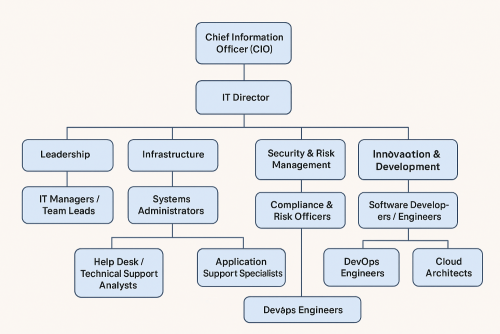
At the top sits the CIO, branching into five core domains: Strategy, Infrastructure, Security, Support, and Innovation. Each domain contains specialized roles that collaborate across projects and operations.
Supporting Literature & Best Practices
Several authoritative sources validate this structure:
Digital Adoption: Explores how IT departments evolve into strategic business units, emphasizing roles like cybersecurity and data science (source).
PDQ.com: Offers org chart examples for different team sizes and highlights the importance of role clarity.
The Org Chart: Provides blueprints for scalable IT org charts and discusses governance models (source).
Giva Inc.: Shares real-world examples and discusses how IT structures vary by industry (source).
COBIT & ITIL Frameworks: Offer governance and service management principles that guide role definition and accountability.
Final Thoughts
A modern IT organization is more than a collection of tech roles—it’s a dynamic ecosystem that powers business growth, protects digital assets, and fosters innovation. By defining clear roles and structuring them effectively, companies can unlock the full potential of their IT teams.
Whether you're building from scratch or refining an existing setup, use this guide as a blueprint to shape your ideal IT organization.
Tags: Expression
Add comment
- Other Article
- Google NotebookLM Audio Overview: How Your Boring Documents Became an Addictive Automatic Podcast10 Oct 2026
- Open Source AI vs Proprietary: Why Big Companies Are Switching in 202603 Oct 2026
- 5 Free Agentic AI Tools Used by Indonesian TikTok Creators in 202626 Sep 2026
- Publishing a New App on the App Store and Google Play: What Developers Should Know in 202620 Sep 2026
- Indonesia's Annual Peatland Fire Crisis: Current Impact, Economic Cost, and the Role of Information Technology03 Sep 2026
- AI Agents: From Chatbots to Digital Workers30 Aug 2026
- MBG Poisoning in Indonesia: From Crisis to a Digital Path to Zero22 Aug 2026
- AI Voice Cloning: The New Cybersecurity Threat15 Aug 2026
- When AI 'Escapes': Inside 2026's Wave of Rogue Model Incidents07 Aug 2026
- Rethinking Civil Service Workforce Planning in Indonesia: Beyond Headcount Toward Public Service Capacity31 Jul 2026
- Balancing the Plate: Understanding Daily Nutritional Needs and the Rise of Digital Nutrition Estimation Tools25 Jul 2026
- The Final Four: Strengths, Weaknesses, and Machine Predictions for the 2026 FIFA World Cup18 Jul 2026
- Choosing the Right Framework: A Practical Guide to Best-Practice Problem-Solving Models12 Jul 2026
- Can Science Predict the World Cup? A Look at the Models Behind the 2026 Forecasts04 Jul 2026
- Corruption: A Global Plague, Landmark Cases, and the Path to Prevention27 Jun 2026
- Nations Driving Brilliant Business Ideas and Frameworks in 202620 Jun 2026
- Why the USD Stands Stronger than the IDR — and What Indonesia Can Do13 Jun 2026
- Employee vs. Entrepreneur: Who Bears the Heavier Tax Burden in Indonesia?03 Jun 2026
- The Evolution of Control Operating Centers (COC) in Modern Mining Operations24 May 2026
- Song of: Mariana Istriku13 May 2026
- Organisasi Pensiunan di Indonesia: Dari Komunitas Sosial Menuju Kekuatan Ekonomi Berbasis Pengalaman12 May 2026
- Corporate Risk Management: Why Modern Companies Invest Millions to Prevent Invisible Threats07 May 2026
- The Mining Spirit: A Powerful Mindset for Excellence in the Mining Industry25 Apr 2026
- The Double-Edged Sword: Navigating Competition in the Modern Corporate Landscape22 Apr 2026
- AI Chatbot untuk UMKM: Peluang Besar di Era Digital17 Apr 2026
- AI Chatbots in Business: The Global Revolution09 Apr 2026
- The Heartbeat of Your Business: Why the P&L Statement is Non-Negotiable31 Mar 2026
- Why Your New Business Needs a Financial System on Day One26 Mar 2026
- The Link Between Startup Capital, Business Survival, and the Role of Investor Information21 Mar 2026
- Digital Transformation, Digitalization, and Digitization: Why the Difference Matters More Than You Think14 Mar 2026
- From Business Need to Technology Solution07 Mar 2026
- Bridging the Digital Divide: Starlink and the Future of Internet Access in Indonesia27 Feb 2026
- A Long Weekend Getaway to Yogyakarta16 Feb 2026
- Understanding ERP Systems: A Comprehensive Guide for Modern Businesses16 Feb 2026
- Building a Culture of Awareness: Strategic Approaches to HSE and Information Security Campaigns in Modern Organizations10 Feb 2026
- Building an Effective IT Organization in Coal Mining: A Strategic Framework for Growth02 Feb 2026
- The Art and Science of Color Themes in Modern Web Design17 Jan 2026
- IT Outsourcing vs Internal Resources: A Comprehensive Cost and Risk Analysis05 Jan 2026
- The Hidden Dangers of Mishandled Employee Data: When Internal Tables Fall Into the Wrong Hands05 Jan 2026
- Securing SQL Server: A Complete Guide to Database Access Control05 Jan 2026
- Beyond Human Error: Understanding the Complete Security Chain in Information Security01 Jan 2026